

A dealer asks for a revised price on WhatsApp at 6:42 pm. The sales manager reads the message, plans to reply after dinner and forwards a screenshot to the accounts lead. By the next morning, three people have seen the enquiry. Nobody is certain who owns it.
That is the point at which WhatsApp stops being only a messaging tool and becomes part of the company’s operating system.
A WhatsApp CRM connects customer conversations with the records and responsibilities needed to act on them: the customer, company, owner, deal, quotation, task, due date and outcome. It does not make WhatsApp less personal. It gives the team a shared way to continue the work when more than one person is involved.
This guide explains what that means in practice, where the boundaries are and how to tell whether your business is ready.
The short answer
WhatsApp is the channel where the conversation happens. A CRM is the system that keeps the commercial context and the next action. A WhatsApp CRM brings the two together so a message can become accountable work without forcing the team to reconstruct the customer story elsewhere.
The useful test is not whether the product can display a chat. It is whether the team can answer five questions from the same working context:
- Who is this customer?
- What are they asking for?
- Who is responsible for the response?
- What happens next, and by when?
- What was the eventual outcome?
If the system cannot answer those questions, it may be a shared inbox or a messaging integration, but it is not yet doing the full job of customer relationship management.
What changes when WhatsApp becomes customer work
Consider an illustrative example. A 14-person commercial interiors company receives an enquiry from a contractor about furniture for a new site. The first message arrives on WhatsApp. The buyer later emails a drawing, asks for a site visit and requests two quotation options.
In a phone-led process, the history is split across one employee’s WhatsApp, an email thread, a spreadsheet and somebody’s calendar. Each tool contains a fragment. The company depends on the original salesperson to remember how those fragments fit together.
In a well-run WhatsApp CRM process, the team can connect the conversation to a verified contact and company, record the opportunity, assign an owner, schedule the site visit, prepare the quote and preserve the buyer’s response. A colleague can step in without asking the customer to repeat everything.
The difference is not more data. It is continuity.
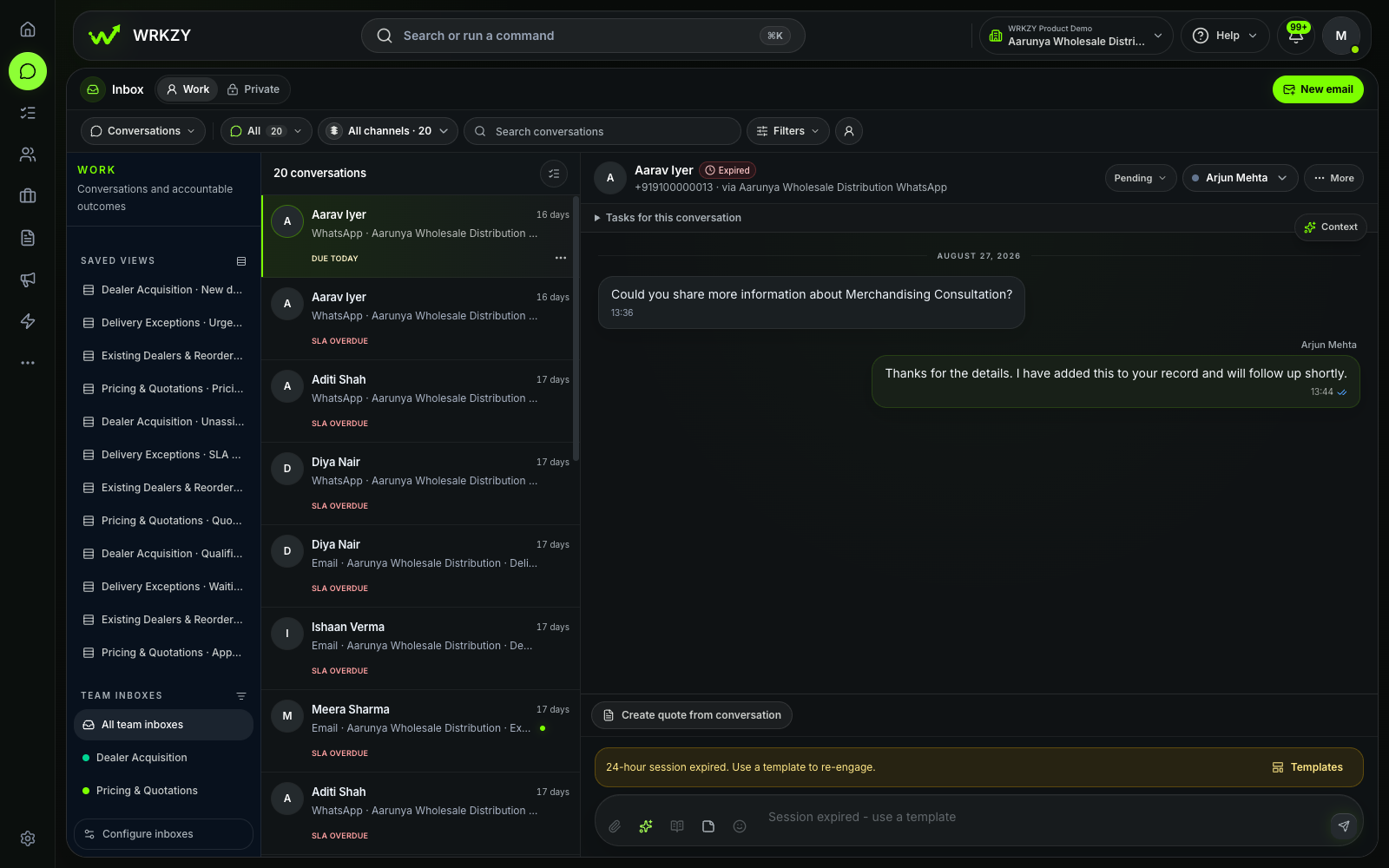 Current productOne active conversation with source and ownerOpen larger ↗
Evidence boundaryThis capture shows one seeded conversation and its visible controls; it does not prove delivery, response or conversion outcomes.
WhatsApp CRM, shared inbox and bulk messaging are not the same thing
These categories often get bundled together, which makes buying decisions harder than they need to be.
| Tool | Main job | What it usually does not solve on its own |
|---|---|---|
| WhatsApp Business App | Help a small business communicate from the app with business-oriented tools | Shared ownership across a growing team and a connected sales record |
| Shared team inbox | Let several people receive and respond to conversations | Deals, quotations, follow-up dates and a durable customer history |
| Campaign or broadcast tool | Send approved outbound messages to opted-in recipients | The day-to-day handling of replies and commercial decisions |
| WhatsApp CRM | Connect conversations to customer records, ownership and downstream work | Good process design, customer consent and sound management judgment |
A business may use more than one of these capabilities. The label matters less than the operating model. Before buying, trace a real enquiry from first message to final outcome and note every point where the team has to copy, forward, remember or ask for context.
The eight-question readiness test
Answer each question with yes, sometimes or no. Use examples from the past 30 days rather than what the process is supposed to be.
1. Do customer conversations regularly involve more than one employee?
If sales, service, operations and finance all touch the same account, individual chat histories are a weak handover mechanism.
2. Can a manager see who owns every open enquiry?
“The sales team” is not an owner. A person or a clearly defined queue must be responsible for moving the work forward.
3. Does every serious conversation end with a dated next action?
“Follow up later” is a wish. “Neha to confirm revised quantity by Thursday, 3 pm” is an operating commitment.
4. Can another teammate understand the account without reading an entire chat?
The customer record should show the essential context: organisation, relevant people, open work, recent decisions and the next commitment.
5. Are quotation versions and buyer responses easy to match?
If the team searches chats to determine which PDF is current, the commercial record is too fragile.
6. Can you distinguish an unanswered message from work that is genuinely complete?
An empty unread count does not prove that the customer received an answer, a decision was recorded or the next action was assigned.
7. Can you measure follow-up without asking employees to prepare a separate report?
Managers should be able to inspect overdue work and recent outcomes from the records created during normal work.
8. Are consent, access and escalation rules defined?
The team needs to know who may contact a customer, which channels are appropriate and when automation must hand over to a person.
Mostly yes means the process may be disciplined enough to improve with a connected CRM. Mostly sometimes means you have the clearest opportunity: ownership exists, but not reliably. Mostly no means the first project is process design, not software configuration.
What a good first workflow looks like
Start with one recurring path, not every customer journey at once. For many Indian SMBs, the right first path is an inbound enquiry that may become a quotation.
- A message enters a shared business channel.
- The team confirms or creates the correct customer record.
- A named owner qualifies the request.
- The owner records the next action and due point.
- If the opportunity is real, the team opens or updates a deal.
- Any quote is linked to the buyer and current commercial context.
- The buyer’s decision and the team’s next step are recorded.
The workflow should remain legible when the original employee is unavailable. That is a stronger test than whether the team can complete it quickly during a product demonstration.
For a deeper treatment of the first half of this process, read How to manage WhatsApp leads without losing the follow-up. If customers also move between WhatsApp, email and other channels, coordinate conversations around one customer record rather than treating each inbox as a separate customer.
Boundaries worth understanding before you buy
A CRM does not change the rules of the channel. Businesses using WhatsApp must follow the WhatsApp Business Messaging Policy, including consent requirements and the rules that apply to business-initiated conversations. On the WhatsApp Business Platform, approved templates are used for business-initiated messages outside the permitted service window.
Nor does a CRM prove that a message was understood, a lead is qualified or a quote will be accepted. Provider states, views and clicks are useful evidence with limits. The commercial outcome still depends on the offer, timing, customer need and quality of the team’s response.
Automation also needs an exit. If a customer asks something sensitive, ambiguous or outside the designed path, the person taking over should receive the conversation and its context. Automation without ownership merely moves the gap.
How to evaluate a WhatsApp CRM in a live demonstration
Bring one anonymised customer journey to the demo. Ask the vendor to show the whole path rather than a polished set of disconnected screens.
Watch for these details:
- Can a new message be matched to the right customer without creating duplicates?
- Can the conversation be assigned, reassigned and handed over with context?
- Can the owner create a dated follow-up from the conversation?
- Can the team see relevant deals and quotations without leaving the customer context?
- Are channel, role and audit boundaries clear?
- Can a manager find unattended or overdue work?
- What happens when delivery fails, the customer replies unexpectedly or an employee leaves?
Ask the demonstrator to show the exception path. The ordinary path is rarely where teams lose work.
Start with continuity, not volume
The best reason to adopt a WhatsApp CRM is not that the business receives a large number of messages. It is that customer commitments deserve a reliable path from the first request to the final decision, even when people change or work crosses teams.
Choose one team, one business number and one recurring workflow. Agree what counts as a qualified enquiry, who can own it, when follow-up is due and which outcome closes the work. Then configure the software around those decisions.
See how WRKZY connects a team inbox with customer context and owned work.