

The lead was not lost in a complicated sales funnel. It was lost in a perfectly ordinary WhatsApp chat.
A buyer asked whether 50 units could reach Pune before the end of the month. A salesperson answered two questions, promised to confirm stock, and starred the conversation. By Tuesday, newer messages had pushed it down the list. Nobody else knew a promise had been made.
That is the problem with treating WhatsApp itself as the lead-management system. The conversation is easy to start, but a chat does not automatically show whether the enquiry is worth pursuing, who owns it, or when the next action is due.
To manage WhatsApp leads, preserve the original conversation, decide whether it contains a genuine sales need, name one responsible person, set a dated follow-up, and record the outcome. A shared inbox helps the team see the chat. A CRM workflow keeps the opportunity from depending on somebody's memory.

A WhatsApp chat is not yet a lead
An inbound message is a signal. It becomes a sales lead only after the team has enough information to judge that there may be a genuine commercial need.
“Hello” is not a qualified lead. Neither is a delivery complaint from an existing customer, a job application, or an unsolicited pitch. Putting every inbound message into the pipeline creates busy-looking reports and hides the enquiries that deserve attention.
The first job is classification, not persuasion.
| What arrives | What the team should do next |
|---|---|
| A new buyer asks about availability, price, fit, or terms | Ask enough to understand the need and decide whether to qualify it |
| A vague “Hi” or “Price?” | Ask one useful question before creating a deal |
| An existing customer reports a service problem | Route it to the responsible service workflow and preserve the relationship |
| A supplier, candidate, wrong number, or spammer writes in | Classify it correctly; do not inflate the active sales pipeline |
| A person asks not to be contacted | Record and respect the preference instead of scheduling another sales touch |
Qualification does not need a long questionnaire. For many teams, three facts are enough to make an initial call: what the person is trying to buy or solve, whether your business can reasonably help, and what timing or constraint matters.
The five steps of a reliable WhatsApp lead workflow
- 01Incoming messageKeep the customer’s words and channel
- 02Qualify the needDecide whether there is a real sales question
- 03Name the ownerOne person carries the next decision
- 04Set the follow-upRecord the action and when it is due
- 05Record the outcomeProgress, pause, close, or hand over
The workflow is short on purpose. Each step answers a question that a chat alone leaves open:
- Incoming message: What did the person actually ask, and through which number or campaign did they arrive?
- Qualify the need: Is there a credible reason for a sales conversation now?
- Name the owner: Which teammate is responsible for the next decision?
- Set the follow-up: What must happen next, and at what date and time?
- Record the outcome: Did the lead progress, pause, decline, or turn out not to be a lead?
The system does not need to be elaborate. It does need to make those answers visible to the people who are expected to act.
Preserve the message that made the lead matter
A weak handoff says, “Hot WhatsApp lead. Please call.” A useful handoff lets the next person see the buyer's words, the number they used, what has already been promised, and the details that shaped the conversation.
Keep the source conversation connected to the contact and any commercial record that follows. Summarise the decision when that helps, but do not replace the customer's actual request with a vague note. The original thread is where a teammate can check whether “next Friday” meant a delivery date, a decision date, or the next time the buyer wanted to hear from you.
Add only the context that changes the next decision: location, intended use, quantity, budget boundary, timing, relevant history, or decision-maker status. Customer Context should reduce repeated questions, not become a dumping ground for everything the business knows.
Let the team see it, then give one person responsibility
A shared inbox solves an important visibility problem. It lets authorised teammates work from a common conversation instead of forwarding screenshots or asking who has the company phone. Visibility, however, is not ownership.
If five people can see a lead and none is responsible for it, the practical owner is still nobody. Assign the conversation to the person who can make or coordinate the next decision. That may be the salesperson who first replied, a territory owner, a product specialist, or the teammate already responsible for the account.
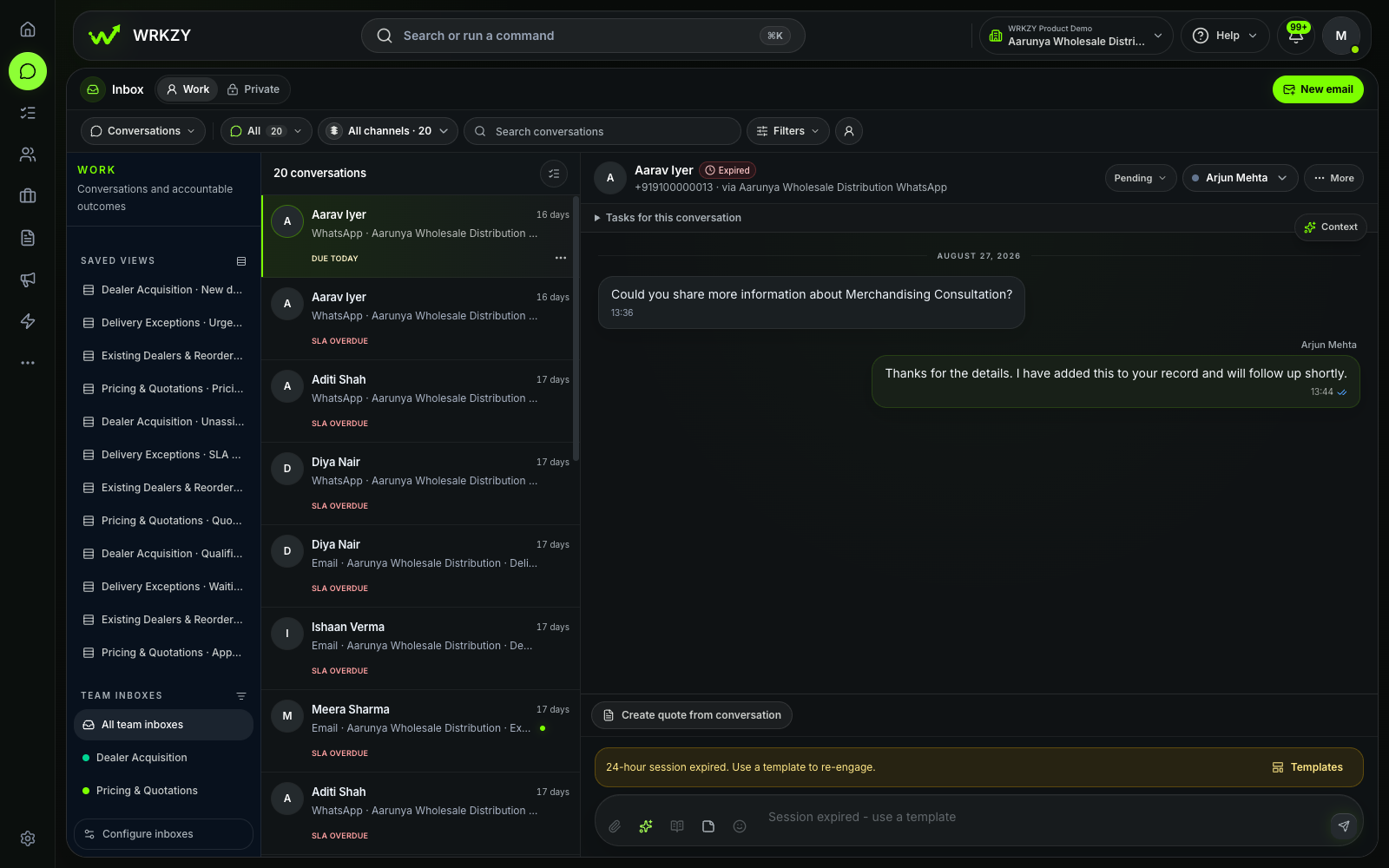 Current productOne active conversation with source and ownerOpen larger ↗
Evidence boundaryThis capture shows one seeded conversation and its visible controls; it does not prove delivery, response or conversion outcomes.
In the WRKZY Inbox, the shared thread and named owner can remain together. The operating test is simple: could another authorised teammate open the conversation and immediately tell who owes the customer the next response?
Turn “I'll follow up” into a real commitment
“Follow up next week” sounds adequate while the conversation is fresh. Three days later, it leaves too much to reconstruct. Follow up about what? After which dependency? On which day? Who is doing it?
A useful next action contains an action, its reason, an owner, and a due point:
Nisha to send the revised 50-unit delivery estimate after the stock review, Thursday at 3 p.m.
That sentence is executable. A colleague can understand it, the owner can find it among due work, and the team can tell when it is late. Use Tasks when the work belongs to a teammate and has a real completion point; use a concise note for context that does not itself require action.
Do not continually move the due date to make an overdue list look clean. A missed or rescheduled follow-up is operating information. It may reveal an unrealistic promise, an overloaded owner, or a dependency that should have been made visible earlier.
Create a deal when there is something worth managing
Not every useful conversation needs a deal on the first message. Create one when the team has a plausible commercial opportunity and needs to manage value, stage, evidence, or several actions beyond the inbox.
Good entry criteria are specific to the business. They might include a confirmed product need, a viable market or location, an expected buying period, and agreement on the next commercial step. The point is not to make qualification bureaucratic. It is to stop the pipeline becoming a second inbox.
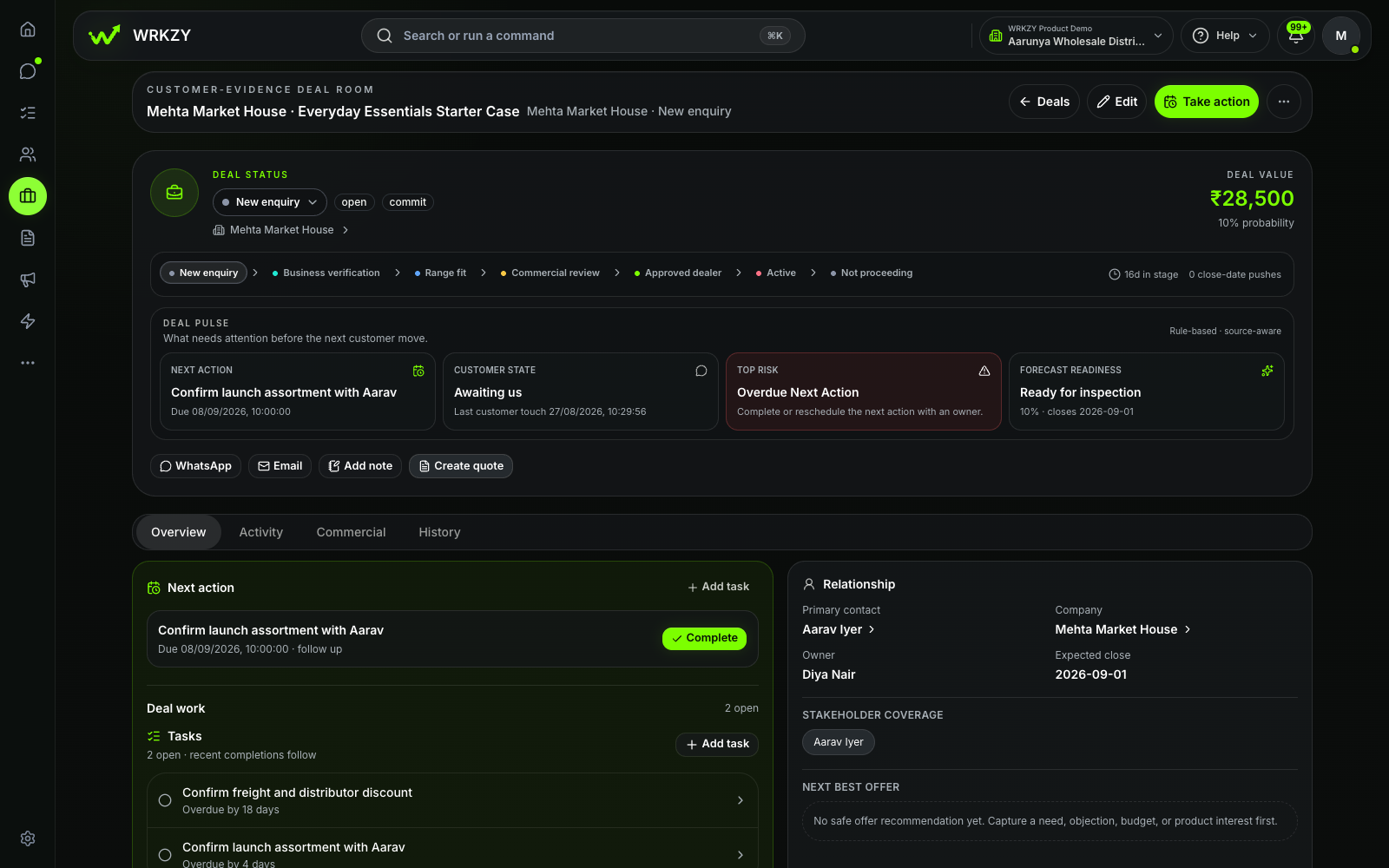 Current productDeal pulse, ownership and next actionOpen larger ↗
Evidence boundaryThis capture shows one seeded deal record and its visible workflow state; it does not prove that the deal will close.
Once qualified, connect the conversation to a deal in Pipelines and mark the clearest open task as the next action. A stage name such as “Proposal sent” is not a follow-up plan. The deal should still answer what the customer is deciding, which evidence supports the stage, and what happens next.
Follow up without becoming the business that will not stop messaging
A CRM can remember to contact someone. It cannot decide that every reminder deserves to be sent.
Before following up, read the latest exchange. Check whether the customer asked for more time, declined, went quiet after a specific question, or is waiting for something from your team. Then write for that situation. “Any update?” makes the customer do the work of reconstructing the conversation. “You were checking whether the revised delivery date works for Pune; would Friday or Monday suit you better?” gives them a decision they can answer.
There is no universal day-three, day-seven, day-fourteen cadence that fits every sale. A simple purchase, a complex implementation, and a seasonal wholesale order move at different speeds. Set timing around the customer's stated process and the real commercial next step.
For practical wording at different stages, use these seven WhatsApp sales message templates. Adapt them to the conversation; do not treat them as a reason to send a message the customer neither expects nor needs.
Record the answer, including “not now”
Lead management is not complete when a message is sent. It is complete when the outcome is understood and the next state is visible.
Use a small, honest set of outcomes:
- Qualified and active: there is a credible opportunity and a current next action.
- Later: the need may be real, but the customer named a later time or trigger. Record it rather than pretending the lead is active now.
- Declined or lost: the customer chose another option, the fit was wrong, or the opportunity ended. Capture the useful reason without turning it into a blame exercise.
- Service or account work: the message matters, but it belongs with an existing customer request rather than in the sales pipeline.
- Duplicate, spam, wrong number, or opt-out: close or suppress it appropriately so it does not keep returning as sales work.
“No response” is an observation, not a permanent stage. After a reasonable, permission-aware attempt, choose what the record now means. Leaving hundreds of silent conversations marked active makes it harder to see the buyers who are actually waiting.
Run a ten-minute WhatsApp lead review each week
Reports help only when they lead to a decision. Once a week, a sales lead or inbox owner can scan for six exceptions:
- worthwhile enquiries with no assignee;
- follow-ups that are overdue or repeatedly rescheduled;
- active sales chats with no deal or dated next action;
- open deals whose latest conversation has no clear response owner;
- opt-outs or stop requests that have not been recorded; and
- conversations whose outcome is still unknown after the agreed review point.
Discuss the exceptions, not every message. Reassign work when the owner cannot act, close items that are no longer real, and repair the records that would force another teammate to ask for a private briefing.
The aim is not a perfectly tidy CRM. It is a trustworthy answer to one everyday question: Which WhatsApp leads need attention now, from whom, and why?
To connect conversations, customer context, deals and follow-ups in one operating flow, explore WRKZY for sales.