Cross-team customer handoffs

Give the next team the promise, owner, and next action—not a transcript.

Prepare the handoff from live customer evidence, route it to the responsible team, name the person carrying the next decision, and keep the customer-facing return path visible until the promised outcome is complete.

For cross-functional teams whose customer work changes hands before it is completeWhatsApp and email available today
Current productSanitized WRKZY demo workspace
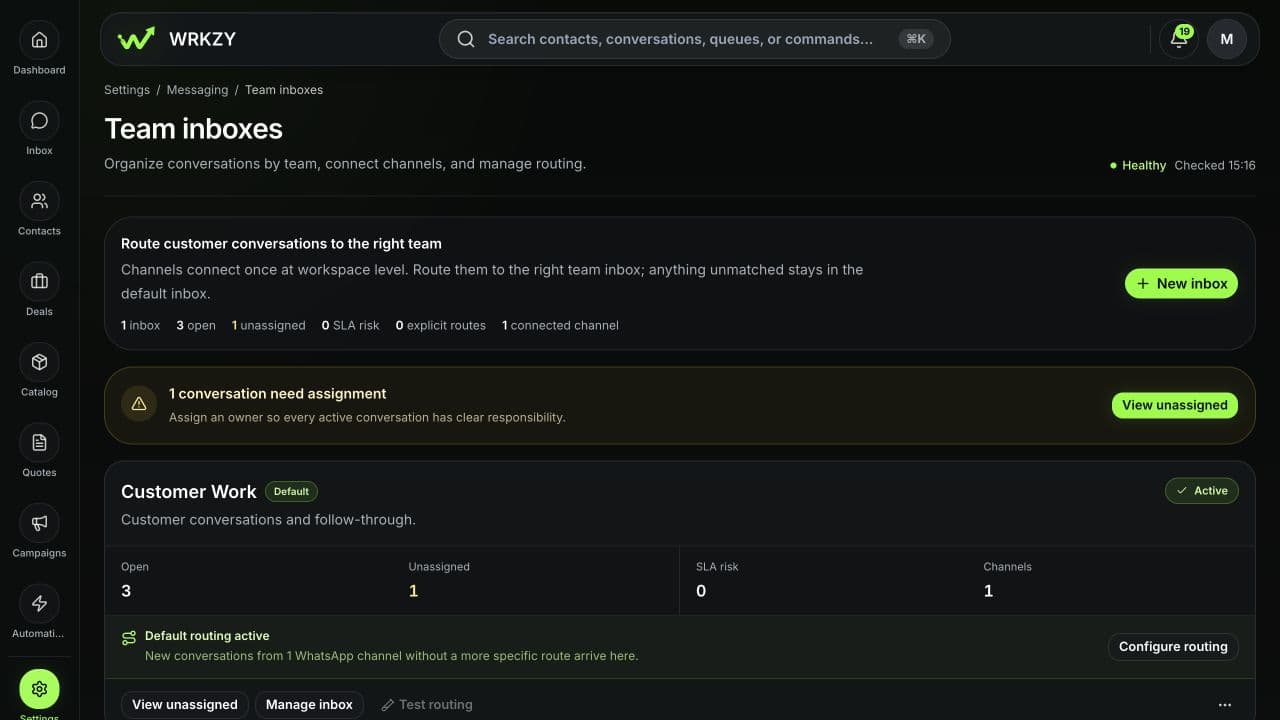
WRKZY Team Inbox settings showing a default Customer Work destination, one connected WhatsApp route, three open conversations, and one unassigned conversation.
See where shared work lands—and what still has no owner.

The Team Inbox view proves the configured destination, connected route, open work, and one unassigned conversation. Acceptance and completion require the operating steps shown below.

  • Configured team destination
  • Connected route
  • Unassigned work requiring attention
01The sending team states what remains02The next owner explicitly accepts responsibility03The customer promise and due time remain visible04Completion has a return path to the customer

Where handoffs break

The conversation moved. Responsibility did not.

Sales promises an availability check, support receives the buyer's follow-up, and operations is asked to investigate in a side chat. Everyone can see part of the story, but nobody can prove who accepted the next action. This is an illustrative scenario—not customer proof.

  • The receiving team gets a transcript instead of a decision-ready brief.
  • The customer promise loses its owner or due time during the transfer.
  • The sending team cannot tell when to return to the customer.
Illustrative cross-team handoff
Before
  1. 01
    ForwardA message or screenshot is sent to another team.
  2. 02
    ReconstructThe recipient searches for the customer and earlier promise.
  3. 03
    AssumeEach team assumes the other owns the response.
  4. 04
    Customer chasesThe missing return path becomes visible too late.
With WRKZY
  1. 01
    PrepareState the customer, promise, current state, and remaining action.
  2. 02
    RouteSend the work to the team responsible for the outcome.
  3. 03
    AcceptName the next owner and due time explicitly.
  4. 04
    ReturnRecord completion and trigger the customer-facing response.

A handoff both teams can inspect

Move responsibility without making the next team rediscover the work.

A useful handoff separates routing from acceptance. It carries only the context needed to act, then keeps the return path visible until the customer outcome is complete.

  1. 01

    Prepare from current evidence

    Customer context
    You do

    Open the customer, conversation, linked work, and promise before transferring responsibility.

    WRKZY keeps visible

    Use shared customer context to state what is complete and what remains.

    Outcome

    The handoff begins with a decision-ready brief instead of a forwarded transcript.

  2. 02

    Choose the responsible destination

    Workspaces
    You do

    Route the work to the team whose responsibility, access, or service expectation fits the outcome.

    WRKZY keeps visible

    Use a team inbox inside the existing workspace unless a genuine business boundary requires another workspace.

    Outcome

    The work lands where the receiving team is expected to monitor it.

  3. 03

    Name and confirm the next owner

    Inbox
    You do

    Assign one teammate and make acceptance explicit.

    WRKZY keeps visible

    Keep team destination, assignment, priority, and due action beside the active work.

    Outcome

    Routing no longer masquerades as ownership.

  4. 04

    Execute with the promise intact

    Customer context
    You do

    Complete the operational or commercial action using the linked evidence and due time.

    WRKZY keeps visible

    Keep the customer promise, linked conversations, dependencies and blockers with the owned work.

    Outcome

    The receiving team can act without asking the customer or sender to restate the situation.

  5. 05

    Record completion and return

    Automations
    You do

    Mark the outcome, notify the responsible team, and complete the customer-facing response.

    WRKZY keeps visible

    Record a completion note or message evidence, then let the customer-facing team check what was done.

    Outcome

    The handoff ends in a customer outcome, not an internal transfer.

Product evidence and operating model

Use evidence that helps the next owner decide and act.

Current product captures show customer context, active work, and configured steps. The handoff receipt below is an illustrative operating model, clearly separated from product proof.

01

Handoff context

Carry the relationship, open work, and current promise.

The receiving teammate needs the customer identity, relevant recent activity, linked commercial or service work, and the commitment that explains the next action—not every historical detail.

Explore customer context
Current productSanitized WRKZY demo workspace
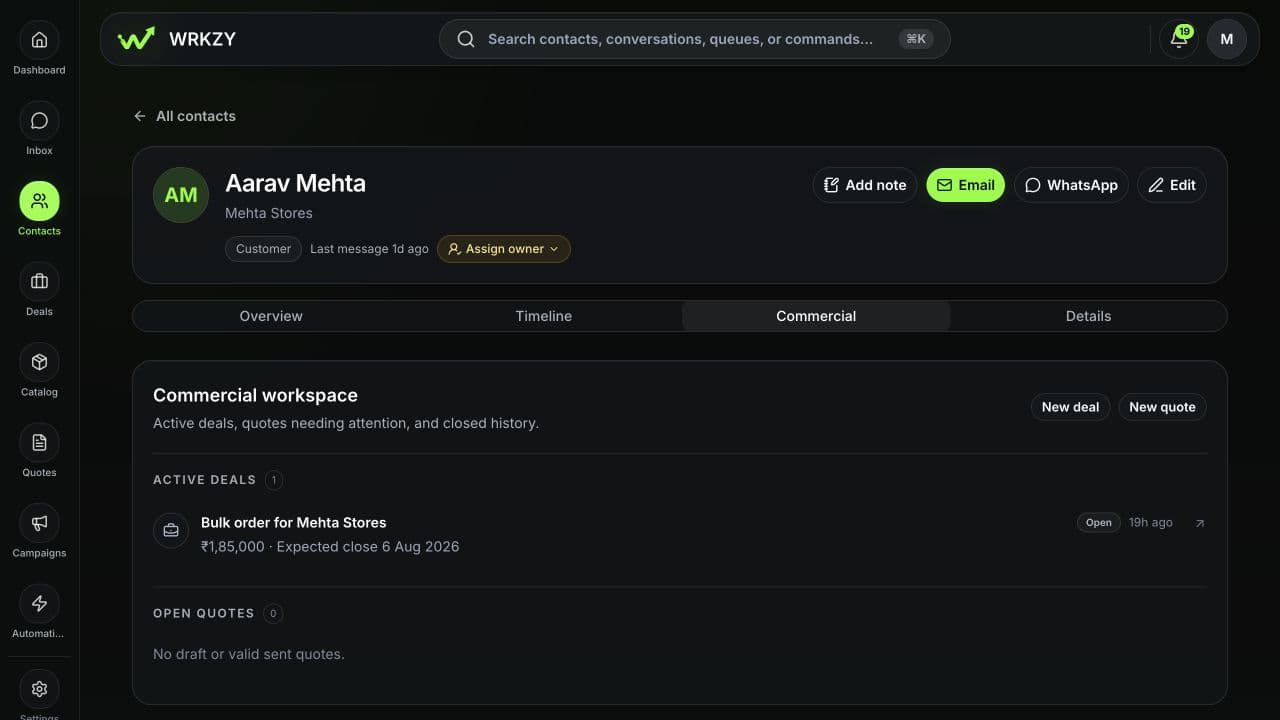
WRKZY Commercial customer view for Aarav Mehta at Mehta Stores with Email, WhatsApp, and Assign owner controls, one open ₹1,85,000 deal, and no open quotes.
Carry the relationship, open work, and current promise.

The current customer view identifies Aarav and Mehta Stores, offers Email and WhatsApp actions plus Assign owner, and shows one open ₹1,85,000 deal with no open quote. The adjacent model explains the wider context categories.

  • Contact and company
  • Email, WhatsApp, and Assign owner controls
  • One open deal and zero open quotes
Illustrative product model
AM
Aarav MehtaMehta Stores · Commercial relationship
IdentityContact · company
RelationshipLifecycle · tags · lists
ConversationWhatsApp · email
CommercialDeal · quote · catalog
CommitmentOwner · follow-up · due date

The next person sees the relationship—not an isolated message.

How the wider operating model fits around the current product view.

    02

    Accepted responsibility

    Keep the live request, owner, priority, and next action together.

    A routed conversation still needs a named owner. Assignment, timing, and an explicit next action show whether the receiving team has accepted the work.

    Explore inbox
    Current productSanitized WRKZY demo workspace
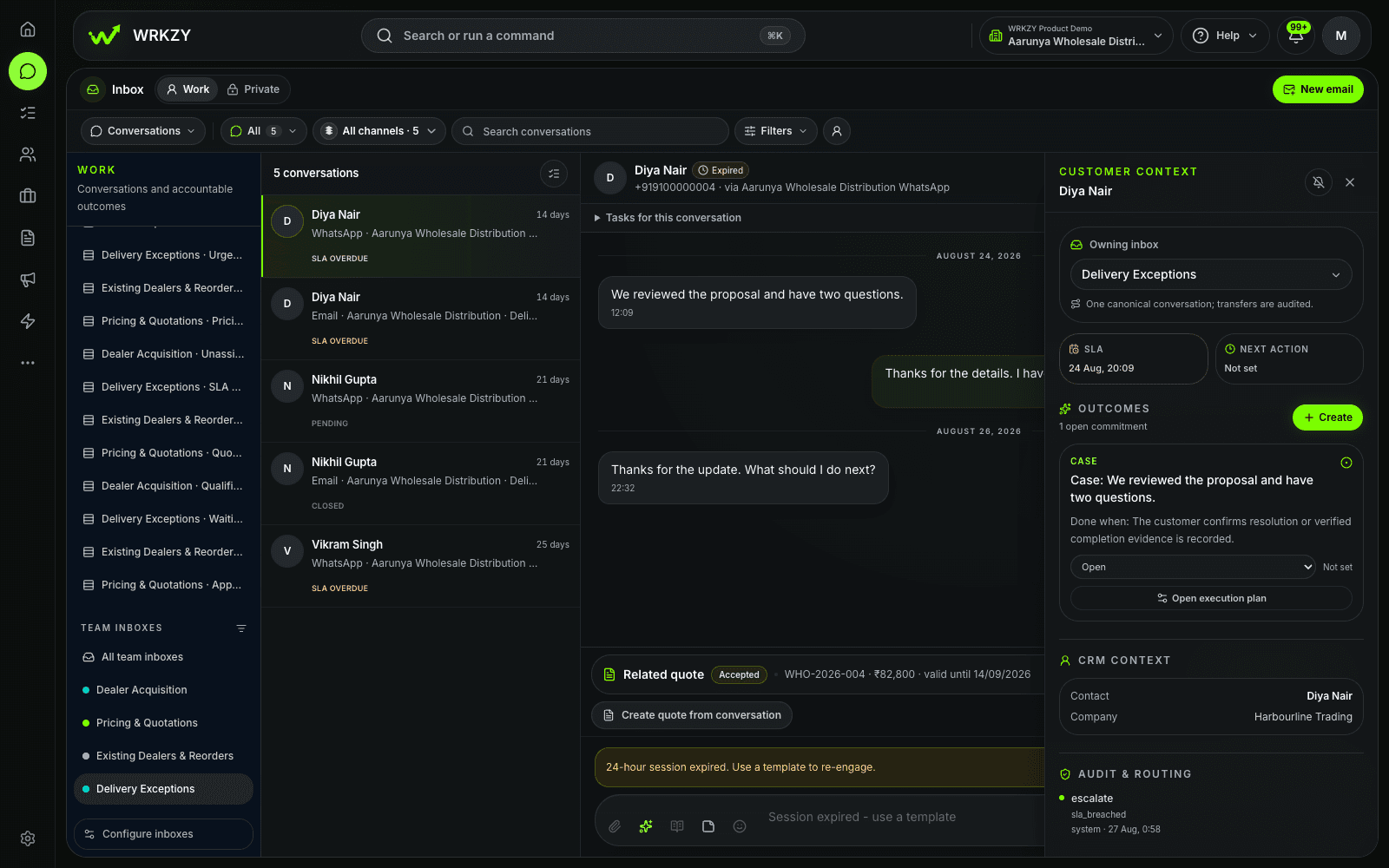
    WRKZY Work inbox with a selected WhatsApp request, responsible teammate, priority, response timing, and overdue next action.
    Keep the live request, owner, priority, and next action together.

    This current Work inbox capture shows a selected request with its channel, priority, owner, response timing, and overdue next action.

    • Responsible teammate
    • Priority and response timing
    • Specific next action
    03

    Repeatable coordination

    Configure the known notification path; expose the exception.

    When the handoff rule is well understood, configure its trigger and predictable actions. Test and review it before activation, and leave ambiguous or consequential decisions with a person.

    Explore automations
    Current productSanitized WRKZY demo workspace
    WRKZY automation builder with a New Contact Created trigger, three visible actions, and Test, Review, Publish, and Turn on controls.
    Configure the known notification path; expose the exception.

    The current builder proves an explicit trigger, visible actions, and test and review controls. The model shows where human decision points fit around that path.

    • Explicit trigger
    • Visible assignment action
    • Test and review before activation
    Illustrative product model
    01
    TriggerNew contact created
    02
    ConditionLifecycle is qualified
    03
    ActionAdd to approved list
    04
    WaitUntil local working hours
    05
    ApprovalReview customer-facing step
    06
    ActionAssign conversation owner
    Before activationTest → review → publishAfter activationLogs → retries → rollback

    How the wider operating model fits around the current product view.

      What improves

      Both teams can tell whether the handoff is prepared, accepted, and complete.

      Inspect these operating signals instead of relying on a message that says ‘passed to the team.’

      01Prepared

      Can the next team act?

      The handoff states what is complete, what remains, and which evidence matters.

      02Routed

      Did it reach the right responsibility?

      The team destination matches the outcome, access, and response expectation.

      03Accepted

      Who owns the next move?

      One teammate and due action make responsibility inspectable.

      04Returned

      Who closes the loop with the customer?

      Completion and the customer-facing return path remain explicit.

      The minimum viable handoff

      Give the next owner an actionable receipt.

      The receipt below is an illustrative operating model. It shows the four fields a team can agree on before it decides whether to configure a recurring route in WRKZY.

      Illustrative handoff receipt
      Availability confirmed; customer response still pending.

      Operations accepted the stock check and recorded the outcome. Sales owns the promised buyer update today at 16:00.

      State
      What is complete, what remains, and why
      Owner
      One person accepted the next action
      Time
      The customer promise or next-action deadline
      Context
      The minimum note and linked evidence needed to act
      Accepted by the next owner

      Start with one fragile handoff

      Make one cross-team promise easier to accept and complete.

      Bring a handoff your team currently manages in chat. Define its state, owner, due time, minimum context, and customer return path in WRKZY.

      Start free trial