

A customer asks a product question on WhatsApp, follows up by email with a colleague copied and returns to WhatsApp the next morning as the deadline gets close. In their head, the conversation never stopped. Inside the company, it has become two queues, two apparent owners and a morning spent asking who replied where.
Forcing the customer back into one channel will not fix the underlying problem. The team needs one coherent view of the relationship while preserving the rules and evidence attached to each route.
WhatsApp and email are available in WRKZY today. They remain sourced channel conversations; they do not need to become one indistinguishable thread. The operating goal is to keep the customer identity, responsible team, current outcome, and next action understandable around them.

A phone number is a route, not a customer
An email address, WhatsApp phone number, or provider identity is a route to a customer. It is not the complete customer record. When teams treat the route as the identity, the same person can look like several unrelated conversations.
Maintain a stable customer identity and associate verified channel addresses with it. This lets the team understand that an email follow-up and a WhatsApp conversation belong to the same relationship without pretending the channels have identical rules or automatically merging their histories.
Before linking or merging identities, verify the relationship using authorized information. A matching name alone is not enough when it could join two different people or organizations. A convenient merge is not worth a privacy or accuracy mistake.
Keep the channel label
When conversations appear in a shared workspace, retain the source channel, connection, timestamps, participants, and delivery state. A teammate should be able to understand where a message came from and which connected account was used without opening the provider in another tab.
That source matters whenever a provider applies channel-specific permissions, templates, delivery states, charges or communication windows. Shared context should save reconstruction time without hiding the obligations attached to the original route.
Treat the provider as the authority for those obligations. Re-check the WhatsApp Business Messaging Policy for WhatsApp use and Google’s email sender guidelines when sending to Gmail recipients; WRKZY guidance does not replace either provider’s current rules.
Make one person responsible for the follow-up
Multiple inboxes create multiple apparent owners. The email team owns the email, the messaging team owns the chat, and nobody clearly owns the promise made to the customer.
Coordinate around the next customer outcome instead. WRKZY exposes several responsibilities that should not be collapsed into one vague “owner” field:
| Responsibility | What it answers |
|---|---|
| Team inbox route | Which team receives a new sourced conversation? |
| Conversation assignee | Who is handling this thread now? |
| Relationship or deal owner | Who carries the broader customer or commercial decision? |
| Next-action owner | Who must do what, and by when? |
One person may hold more than one role, but the current outcome still needs a single accountable owner. If another team must decide, hand off that outcome with the decisive context rather than assigning fragments of the same request in each channel.
Use internal notes for coordination and the appropriate customer channel for customer-facing communication. Otherwise, two well-meaning teammates can send two different answers to the same customer.
Here is the kind of note that prevents that collision:
Leena moved from email to WhatsApp to confirm Monday delivery. Sam owns the delivery check and will reply in the WhatsApp thread by 2 p.m. The email chain remains the source for the approved address and purchase reference.
It is short because it does not copy the conversation. It names the switch, the source that still matters, the owner, the reply channel and the due time.
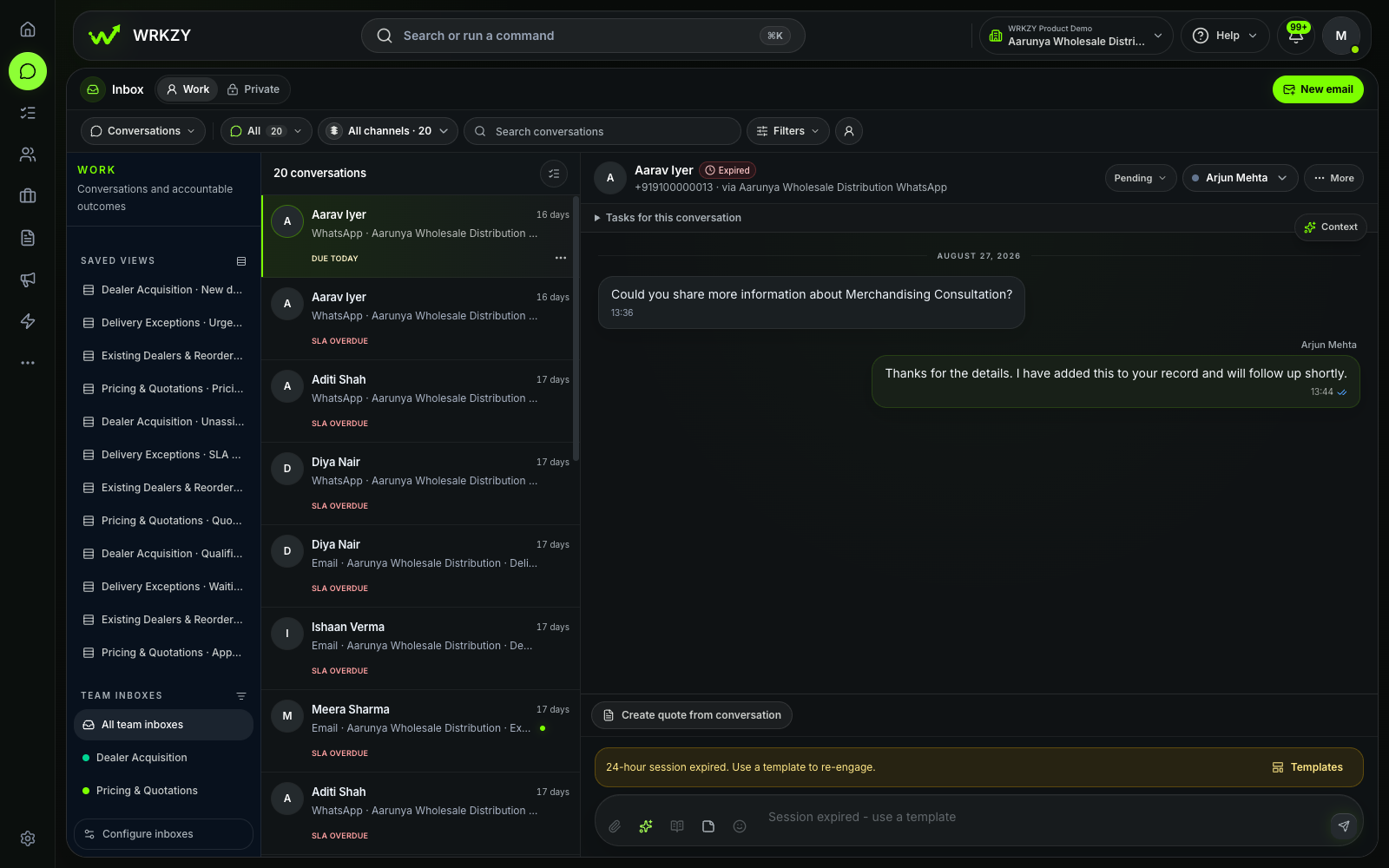 Current productOne active conversation with source and ownerOpen larger ↗
Evidence boundaryThis capture shows one seeded conversation and its visible controls; it does not prove delivery, response or conversion outcomes.
Get one channel working before adding another
A connected account is not yet a coordinated customer workflow. For each company-owned WhatsApp sender or shared email address:
- connect the account to the intended workspace;
- route new conversations to the responsible team inbox;
- send one controlled inbound test from an approved external account;
- confirm the customer identity, channel label, inbox, and assigned or unassigned state;
- send one harmless reply and inspect the available delivery state; and
- ask another authorized teammate to identify the owner and next action without calling the last responder.
Private Mail is different from a shared email connection. It remains owner-scoped until its owner deliberately shares approved context or moves future customer work into the team-managed surface.
Choose the channel for the next action
The latest inbound channel is often the natural place to continue, but it is not automatically the correct channel for every action. A quick confirmation may belong in messaging; a sensitive document or detailed commercial change may need a different route.
Before switching channels, check:
- whether the customer has given or withdrawn the relevant permission;
- whether the receiving identity has been verified;
- whether the content is suitable for that channel;
- whether provider-specific requirements apply; and
- whether the switch will make the operating history harder to understand.
Record the reason for a consequential switch. The next teammate should not have to guess why a quote, security question, or service update moved elsewhere—and the customer should not have to repeat the context after following you there.
Use the decision, not convenience alone, to choose the route:
| Situation | Operating choice | Record before continuing |
|---|---|---|
| A quick confirmation on the current sourced thread | Continue in that channel when permission and provider rules allow | Current owner and next action |
| A sensitive document or material commercial change | Verify the recipient and use the suitable approved route | Reason for switching and authoritative record |
| Another team must decide | Hand off the customer outcome, not a copied fragment | Decisive context, accepting owner, and due point |
Record the result where the team can find it
After the conversation moves, update the shared context: the current owner, decision, status, and next action. Link or update the relevant contact, deal, quote, task, or follow-up instead of copying entire channel histories into a new note.
Periodically review duplicate identities, inactive connections, unresolved delivery states, and conversations with no owner. These are early signals that channel activity is drifting away from customer operations.
Can another teammate pick up the conversation?
Review a sample of real customer journeys across WhatsApp and email. Track whether inbound work reaches the intended team inbox, how many active conversations remain unassigned, how many channel switches lack a recorded reason, how many delivery exceptions remain unresolved, and whether the next teammate can identify the current outcome and next action without rebuilding the story.
These are operating measures, not a count of channels on one screen. Coordination is working when a customer can change routes without losing the relationship and another teammate can continue without asking the customer to start again.
For teams choosing the channel setup behind this workflow, compare the WhatsApp Business App, Business Platform and CRM operating models.
See how the WRKZY Inbox brings conversations and follow-ups together, then use the setup guide to connect and verify one company-owned channel from end to end.