

WhatsApp is already part of everyday life for more than three billion people. That reach can make it a useful business channel, but reach does not make every message useful. A vague greeting, generic promotion, or context-free follow-up is still easy to ignore.
Sending more messages is not the answer. Send the right message for the current stage of the customer conversation—and make the next step easy to understand and answer.
The seven examples below are adaptable templates, not claims from a customer case study. Replace every bracketed prompt with accurate context from the conversation, and use only proof, offers, and deadlines your team can verify.

Before you write: give the message one job
A useful WhatsApp sales message usually does five things:
- identifies why you are writing now;
- uses context the customer has already provided;
- asks for one decision or next step;
- makes the answer low effort; and
- sets an honest expectation about who will respond and when.
This matters more than adding extra enthusiasm or urgency. The customer should be able to scan the message and know what happened, what you need, and what will happen next.
Compare a generic follow-up with one that gives the customer a useful reason to reply:
Generic: “Just following up. Any update?”
Specific: “You were reviewing the onboarding plan for your Mumbai team. Is the rollout date the main point holding up the decision?”
- 01AudienceEligible and expected→
- 02ReviewMessage, sender, and reply path→
- 03SendApproved WhatsApp or email route↓
- 04EvidenceDelivery and channel-specific signals←
- 05ResponseMeaningful reply stays contextual←
- 06Clear follow-upTeammate, due action, and result
1. Reply immediately
Use this after an inbound enquiry when a complete answer needs investigation or a handoff. The message should acknowledge the request without pretending that the work is already complete.
Why it helps
- confirms that the enquiry reached the team;
- gives the customer a realistic response time;
- names the next owner instead of hiding behind “we”; and
- creates a natural place for the customer to add useful context.
Avoid “we will get back to you shortly” when nobody owns the next step or “shortly” has no shared meaning inside the team.
2. Personalise the welcome
A welcome message should do more than insert a first name. Use the source of the enquiry, the page the customer visited, or the need they mentioned to make the opening relevant.
Why it helps
- gives the customer an easier starting point than a blank “How can we help?”;
- shows that the team understands the likely context; and
- keeps room for an answer you did not predict.
Personalization should come from information the customer expects you to use. Do not surface sensitive, private, or unrelated details merely because they are available somewhere in the business.
3. Share proof you can verify
Social proof is useful only when it is real, relevant, and approved for public use. An invented customer count or unsupported conversion figure can damage trust faster than a plain product explanation.
When a verified case study exists:
When there is no publishable customer proof, offer a product example you can verify instead:
4. Make the demo easy to choose
A demo invitation is easier to answer when the customer knows what they will see and can choose between concrete times.
Why it helps
- reflects the need already discussed;
- sets a clear duration and agenda; and
- replaces an open-ended scheduling request with a simple choice.
If the customer has not described a problem yet, ask one useful question before offering a broad product tour.
5. Follow up with context
A follow-up earns attention when it reminds the customer what they were deciding and offers a useful route forward. Repeating the previous message without new context only adds noise.
Why it helps
- makes the earlier conversation easy to recall;
- identifies one likely obstacle without assuming the answer; and
- offers two concrete ways to continue.
Record the follow-up as a next action with an owner and due time. A sent message is activity; a visible customer decision is progress.
6. Be honest about the deadline
Urgency should come from a real commercial boundary—not a disappearing timer that resets for every customer.
Why it helps
- makes the deadline and its reason explicit;
- gives the customer a low-effort response; and
- avoids presenting the offer as confirmed before eligibility or terms are checked.
Keep the current price, terms, scope, and approver connected to the message. If any of them changes, update the source record before sending the next version.
7. Make re-engagement easy
Re-engagement should be relevant to the customer’s earlier need. Use it when something material has changed or when the customer can make a useful decision—not merely because a sequence reached “day 30.”
Why it helps
- explains why the conversation is worth reopening;
- gives the customer control over what happens next; and
- makes the customer’s choice easy to record and respect.
Respect opt-outs and stop signals. A CRM should help the team remember the customer’s preference, not help it keep sending after the customer has said no.
Keep every reply connected to the next sales step
The template is only the message the customer sees. Behind it, the team still needs the source conversation, customer context, current owner, promised timing, and next action.
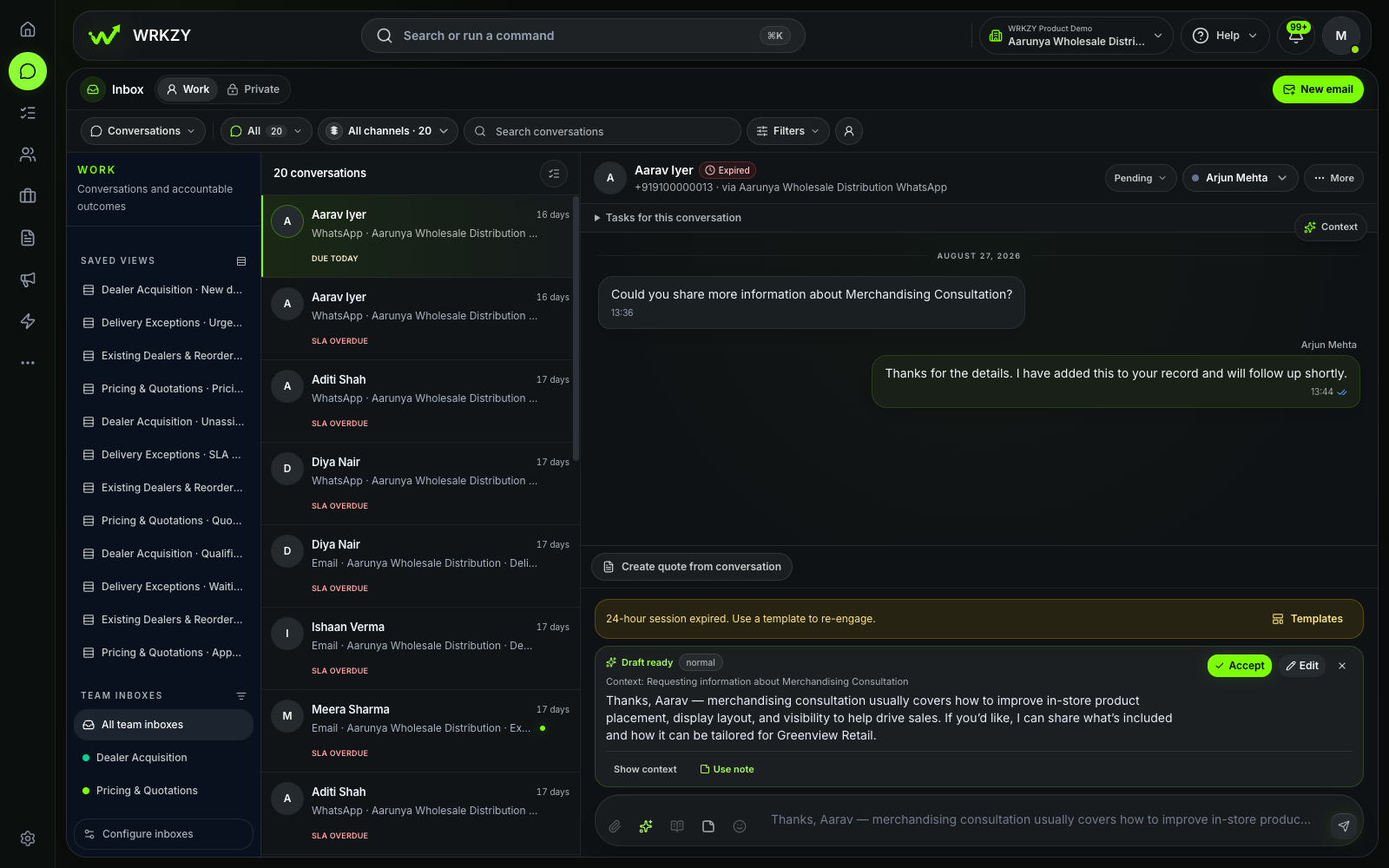 Current productAI-assisted draft under human reviewOpen larger ↗
Evidence boundaryThis capture shows a draft awaiting human review; it does not show that the suggestion was accepted, sent or factually correct.
In WRKZY, a responsible teammate can review a proposed draft beside the source request before deciding whether to accept, edit, or discard it. The final message still needs human judgment: check the facts, tone, recipient, permission, offer, and next step before sending.
Use a small message-quality check:
| Check | Ask before sending | Evidence after sending |
|---|---|---|
| Relevance | Why is this useful to this customer now? | Reply addresses the intended topic |
| Context | Which verified detail makes it specific? | Customer does not need to repeat the request |
| Next step | Is there one clear question or action? | Decision or response state is visible |
| Ownership | Who handles the reply or exception? | Named owner and due action remain current |
| Permission | Is this message eligible and expected? | Consent, template, or service-window state is recorded where required |
Do not optimize only for reply volume. Review whether meaningful replies receive an owner, whether promised follow-ups happen on time, how often customers must repeat context, and whether dormant conversations close with a clear outcome.
The best WhatsApp sales message does not force a conversion. It helps the customer make the next decision with less friction—and helps the team carry that decision forward without losing context or responsibility.
Before selecting a sending setup, compare the WhatsApp Business App, Platform, and CRM by operating need rather than product shorthand.
To see the connected workflow, explore WRKZY for sales.