

Open the last five proposals your team sent. If one says “onboarding,” another says “implementation,” and a third uses last quarter’s price, you do not have five offer definitions. You have five people rebuilding the same offer.
The product image may live in a shared folder, service exclusions in somebody’s notes and the approved currency in a spreadsheet. A seller can still assemble a quote, but first they have to renegotiate what “current” means. That slows the buyer’s decision and makes yesterday’s offer surprisingly hard to explain.
A reusable catalog does more than put products in a database. It gives the team one reviewed definition of what it sells, who may use it and which commercial details are ready to carry into customer work.

First, agree what “reusable” means
A catalog owner and a seller have different responsibilities, but they should agree on one outcome:
A teammate can find one approved product or service, understand its current commercial state, and reuse it in a deal or quote without recreating the source or erasing what was offered before.
That outcome requires more than a name and price. Each offer needs a stable identity, useful customer-facing description, deliberate pricing and visibility, a clear lifecycle, and an owner who reviews change.
The catalog earns its keep when a seller can answer four questions without opening another spreadsheet: Is this the intended offer? Is the price current for this situation? May I use it? Which changes belong in the buyer’s quote rather than the shared source?
Keep each product detail in one reliable place
The catalog is reusable commercial infrastructure, not the whole revenue workflow. Separate the records by the decision they support:
| Commercial need | WRKZY record |
|---|---|
| Reusable product or service definition | Catalog item |
| Price by currency, segment, channel, quantity, or effective period | Catalog price record |
| Evidence that a customer is considering an offer | Customer interest |
| Working scope and expected value for an opportunity | Deal line item |
| Buyer-specific scope, packages, terms, validity, and response | Quote and its revision history |
This separation protects two kinds of truth. The catalog can change as the business changes, while a historical quote can still show what a buyer was offered at that time. A new base price should not rewrite an issued proposal. A buyer-specific discount should not quietly become the reusable default.
Explore the WRKZY Catalog to see how reviewed products and services connect to buyer-specific work. Use the catalog overview when the team needs a shared definition of each record.
Start with the ten offers that cause the most rework
Do not begin by importing every legacy row. Choose the ten products and services that appear most often in customer conversations and proposals. For a retail rollout, that might include the rollout kit, implementation and team enablement.
For each item, the owner reviews:
- a clear customer-facing name;
- product or service type;
- a unique SKU or service code where the organization uses one;
- category, description, and approved image;
- base price, currency, tax rate, unit, and availability;
- scope, deliverables, exclusions, or duration where useful for a service;
- entire-workspace, manager, or owner-and-manager visibility; and
- Active or Inactive status.
Search by name and code before creating anything. A similar record may need a corrected description or another approved price rather than a near-duplicate item. Duplication moves the decision from catalog governance into every future deal and quote picker.
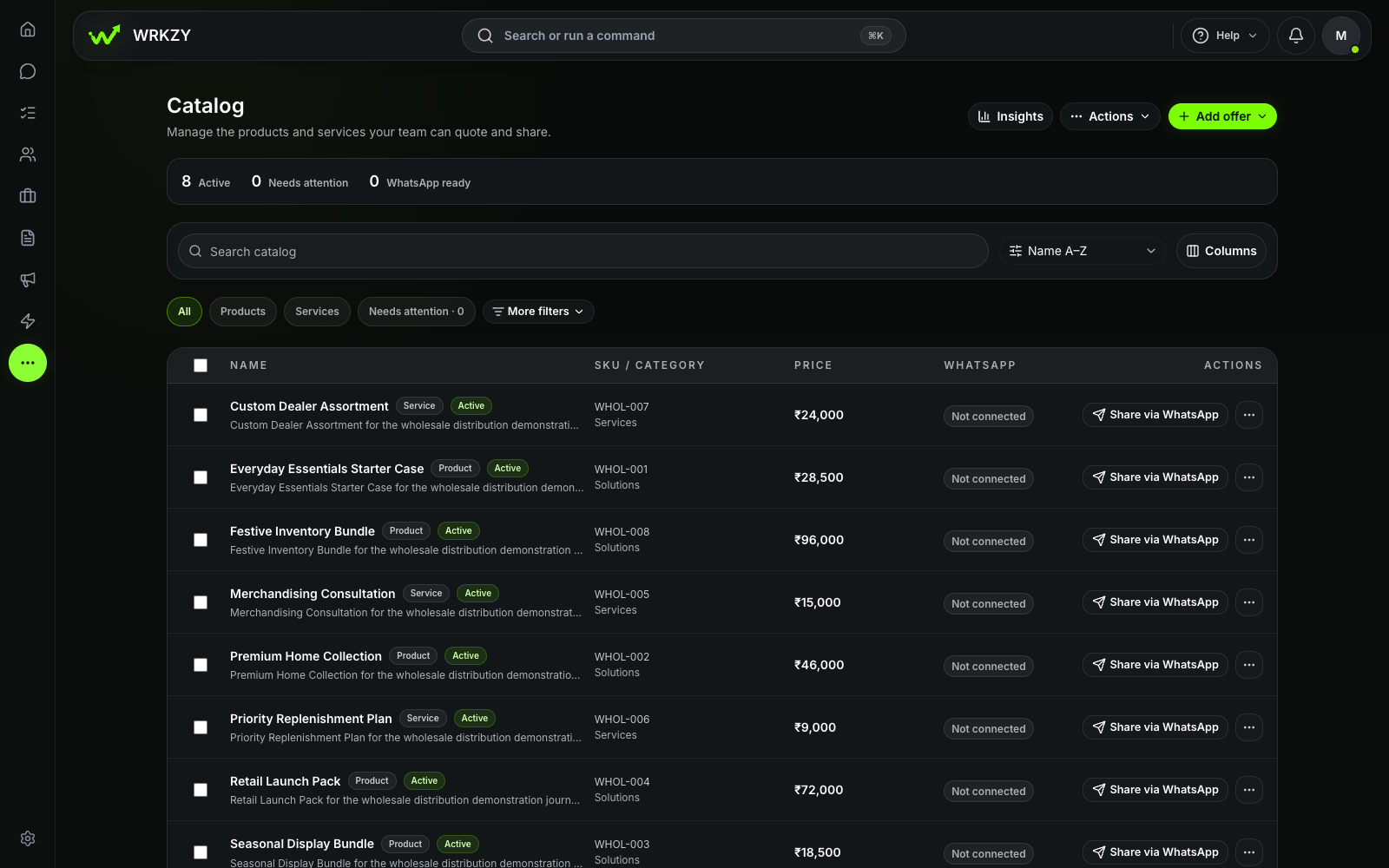 Current productProducts and services ready to quoteOpen larger ↗
Evidence boundaryThis capture shows reusable catalog records; it does not establish stock availability, live pricing or fulfilment capacity.
The screenshot shows where setup begins. It cannot prove that an item has the right price, visibility, tax treatment, external mapping, or owner. Verify those states on the saved record and in the customer workflow that will use it.
Decide who can change prices, access and availability
A single base price is rarely the whole commercial rule. WRKZY supports versioned price records by currency, customer segment, channel, flat or recurring model, billing interval, quantity range, and effective dates. When price approval is required, a Member proposal can remain pending until an authorized reviewer approves or rejects it with a reason.
That flexibility still needs a simple operating contract:
- Owner: who is accountable for the offer’s definition and duplicate prevention?
- Price authority: who may propose, approve, and use commercial changes?
- Visibility: which workspace roles should find the item, price, cost, or margin?
- Effective period: when does a price become usable, and when should it stop?
- Lifecycle: should the offer remain Active, become Inactive, or be Archived?
Active items can appear in new deal, quote, interest, and follow-up pickers. Inactive items remain in the catalog but are unavailable for new selection. Archived items are hidden from active use while their historical quote or interest context remains. Restore an archived item only when it should become eligible again.
Cost and margin are permission-sensitive. Do not widen visibility merely because the selling price is shared across the workspace. Catalog governance should make the minimum useful commercial context available without turning every field into a public team value.
Put the catalog through a real quote
A catalog record earns trust when somebody uses it under real pressure. Select three reviewed offers for a representative deal, then carry them into a quote. Check that names, descriptions, currencies, units, tax and approved prices remain understandable before applying buyer-specific quantities, validity, packages, discounts, terms and approval.
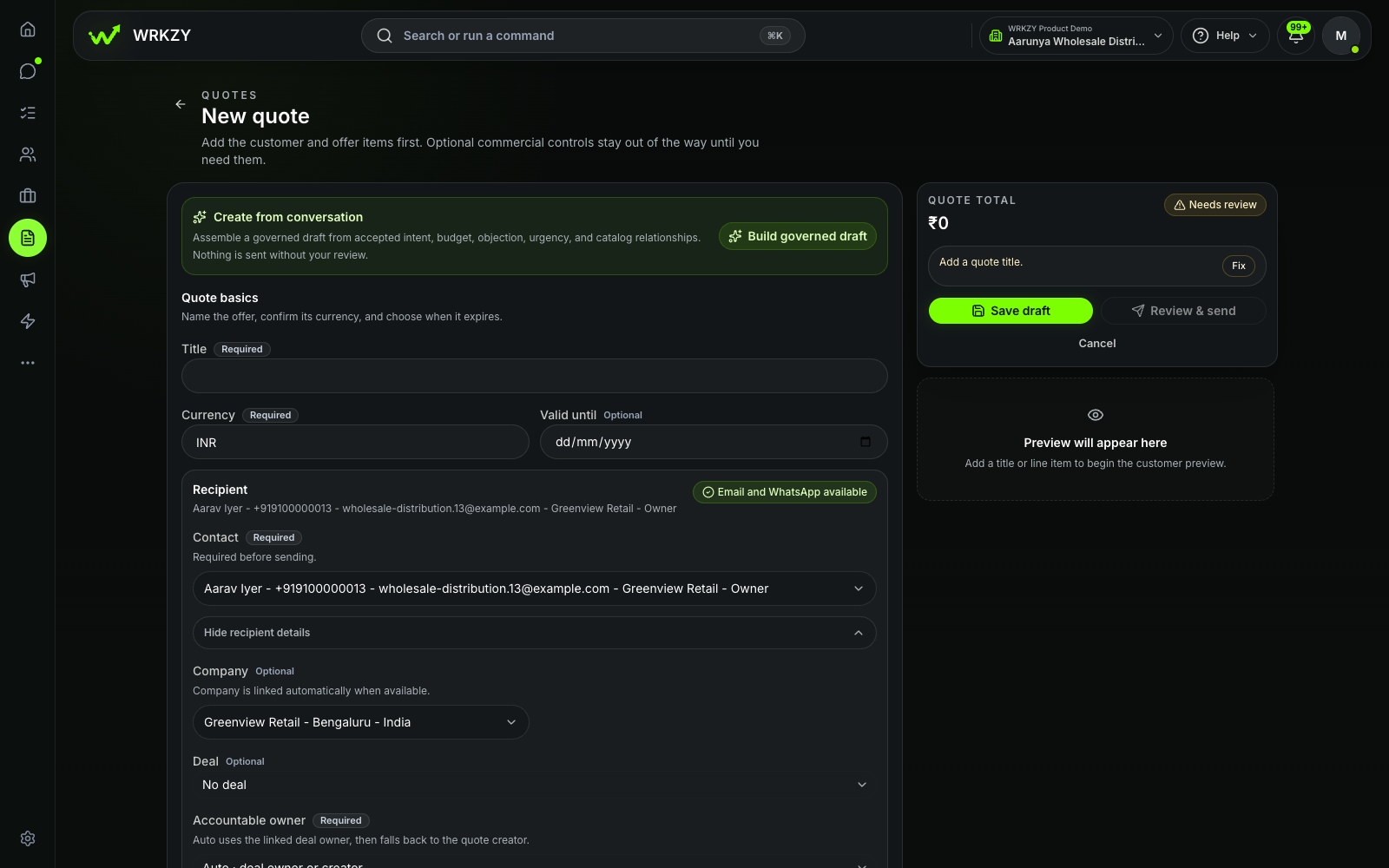 Current productGoverned quote draft with buyer contextOpen larger ↗
Evidence boundaryThis capture shows an unsaved draft and available controls; it does not show that a quote was saved, sent or accepted.
This is the practical boundary: Catalog defines what can be sold; Pipelines carries the opportunity and working scope; Quotes records the reviewed offer this buyer can act on. The quote may legitimately differ from the base catalog because the customer decision adds quantity, package, discount, timing, validity, and terms. The difference should be deliberate and reviewable.
Use the product and service creation guide to verify that an item appears correctly in both Deal and Quote pickers before expanding the catalog.
Change today’s source without rewriting yesterday’s offer
Suppose the implementation price increases next month. The catalog owner creates or approves a price record with its currency and effective period. They do not edit an issued quote to make history resemble the new catalog.
Similarly, when an offer becomes obsolete, archive it instead of deleting it merely to make a list look tidy. Existing quotes and customer-interest evidence need to remain understandable. Clone an item only when the offer is materially different, and record the distinction clearly enough that the next teammate can choose without asking the original catalog owner.
For a larger starting set, WRKZY supports a reviewed CSV import. Begin with a representative file, inspect rows to fix and valid-row previews, and choose the duplicate-code policy deliberately:
| Duplicate policy | Use when | Main risk |
|---|---|---|
| Skip existing active | Current WRKZY records remain authoritative | Intended updates from the file will not apply |
| Update existing active | The reviewed file is the approved source of change | Bad source values can affect future work |
Do not re-import the full source after a partial error. Correct only failed rows, retain their source numbers, and test representative products, services, currencies, taxes, and lifecycle states. The catalog import and export guide gives the complete reconciliation path.
Measure the rework you remove
Review a small operating scorecard rather than treating the number of records as the outcome:
- time to prepare a representative quote from verified customer context;
- duplicate names, SKUs, or service codes found during selection;
- price, currency, tax, or unit corrections made in draft quotes;
- inactive or unauthorized items appearing in new-work pickers;
- offers with stale or unclear price periods;
- imported rows requiring correction after the first preview; and
- high customer interest with no visible owner or next action.
Catalog Insights can surface share activity, interest, quote conversion, objections, price health, channel gaps, and handoff state. Those counts describe recorded WRKZY activity; they do not prove causation or customer intent on their own. A detected product mention should be reviewed against the cited conversation before it becomes accepted customer interest. Compare accepted value by currency rather than combining amounts without current conversion settings.
The catalog insights and customer interests guide explains how to move from a signal to its source evidence and an accountable decision.
Start with ten, not everything
For the first working set, complete this check:
- One owner can explain the naming, price, visibility, and archive rules.
- Every item has a distinct product or service definition.
- Codes, prices, currencies, taxes, units, and effective periods are reviewed.
- Cost and margin remain restricted to authorized roles.
- Inactive and archived items do not appear in new-work pickers.
- One representative deal and quote preserve the intended commercial inputs.
- A future source change will not rewrite a historical buyer offer.
A catalog is ready when the team can reuse it without guessing. Start with the offers behind one current customer decision, verify them end to end, and expand only after the operating rules are clear.
When evaluating the system around that catalog, use the quotation software capability matrix to inspect approvals, revisions, delivery, and buyer responses as well as document creation.
Build the reusable offer behind your next quote in WRKZY Catalog.