

Proposal. Expected to close Friday. From the other side of a pipeline review, that deal looks healthy.
Then the sales lead asks: What customer evidence put it there? Who owns the next decision? What must be true before it leaves? What happens next, and by when?
The stage label cannot answer. Probability is missing, the customer state says Awaiting customer and there is no accountable next action. The team knows where the card is; it does not know whether the commercial work is healthy.
A dependable pipeline needs fewer hopeful columns and more explainable states—clear enough for a seller to use and a manager to challenge.

Give every pipeline stage a clear meaning
A stage should describe a meaningful change in the customer’s commercial decision. Calls, meetings, and record updates belong in conversations, tasks, comments, or history; they do not by themselves prove that the buying decision changed.
Define every stage with four parts:
- Required evidence: the customer, commercial, or operational facts that make the stage true.
- Responsible owner: the one person accountable for progressing the current decision.
- Exit decision: the new evidence or confirmed outcome that allows the deal to leave.
- Next action: the specific owned step and due time that keeps the decision moving.
- Stage 1QualifiedNeed and fit are evidencedNext: Confirm scope→
- Stage 2Scope sharedBuyer received reviewed scopeNext: Resolve open points→
- Stage 3DecisionQuote and stakeholders are currentNext: Record the response→
- Outcome branchWon / LostDistinct evidence and reasonsNext: Start the right follow-through
The names will differ by selling motion, but a compact example could look like this:
| Stage | Required evidence | Responsible owner | Exit decision | Next action |
|---|---|---|---|---|
| New | Verified contact or company with a legitimate commercial question | Intake or deal owner | Qualify the need or keep it as an inbox enquiry | Confirm need, scope, and decision path by a stated time |
| Qualified | Need, likely scope, buying path, and timing are understood | Deal owner | Inputs support preparing an offer | Confirm commercial inputs or prepare reviewed scope |
| Proposal | A reviewed quote or scope was shared with the buyer | Deal owner | The buyer accepts, requests change, declines, or gives a decision path | Review the response by its due time |
| Won | Buyer acceptance and actual close date are confirmed | Closing owner | The accepted outcome and downstream responsibility are recorded | Hand off fulfilment, onboarding, billing, or the agreed next outcome |
| Lost | A declined, displaced, or stopped decision and its reviewed reason are confirmed | Closing owner | The loss reason and any legitimate return path are recorded | Close current work and preserve only the agreed future follow-through |
These are examples, not a universal schema. Different selling motions may need different labels; the four-part test should remain stable.
Keep activity separate from progress
Stage is only one signal in a deal. WRKZY also records owner, priority, probability, forecast category, expected close date, status, and next-action work. Each answers a different question:
- Stage: where is the customer decision in the configured process?
- Owner: who is accountable for progression now?
- Priority: how urgently should the team attend to it?
- Probability: what likelihood does the current evidence support?
- Forecast category: how should the deal contribute to the selected period?
- Expected close: when is the commercial decision currently expected?
- Status: is the outcome open, won, or lost?
Do not use an advanced stage as proof of a close date, treat high priority as a forecast commitment, or assume a default probability reflects current customer evidence. See the WRKZY Pipelines product view for how these signals remain separate without being collapsed into one field.
Remove stages that hide what is really happening
Ask whether two trained teammates would move the same deal from the same source evidence. These designs usually fail that test:
- Activity stages: “Called twice” or “Demo booked” describe team activity, not a changed customer decision.
- Mood stages: “Hot” or “Strong” conceal evidence. Use priority, probability, and forecast category independently.
- Department stages: “With finance” names a queue without the dependency, owner, approval path, or exit decision.
- Premature Proposal: a draft quote does not prove that a buyer received a reviewed offer.
- Calendar movement: time should trigger inspection, not automatic advancement.
- Terminal-stage cleanup: Won and Lost describe customer outcomes; archive describes record lifecycle.
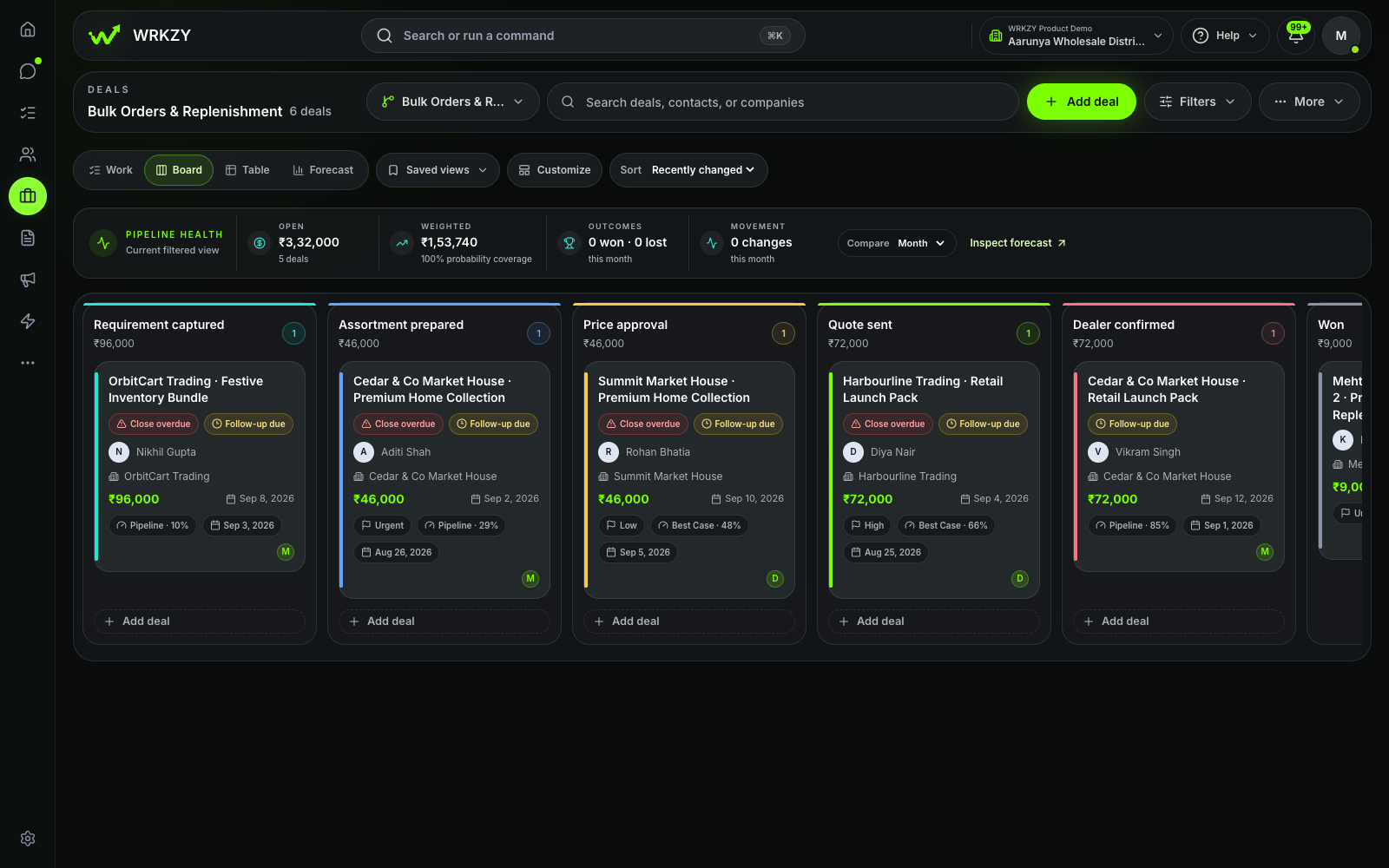 Current productPipeline stages, value and follow-up healthOpen larger ↗
Evidence boundaryThis capture shows seeded pipeline records at one moment; it does not establish forecasting accuracy or future deal outcomes.
This board is useful precisely because it does not present the pipeline as healthy. It makes missing follow-up, incomplete weighted inputs, and overdue timing visible reasons to inspect the underlying deals.
Configure the process in the order people use it
Start with a process the team already runs. Owners and Admins can then translate it into WRKZY without confusing configuration with proof.
- Choose one selling motion. Use sanitized representative patterns to identify where the customer decision changes.
- Define the beginning and outcomes. Decide what qualifies as a deal, which Open stage may accept new work, and what evidence confirms Won or Lost.
- Write the four-part contract. Agree on evidence, owner, exit decision, and next action before configuring controls.
- Configure stage behavior. Set name, color, Open/Won/Lost type, default probability, stale threshold, creation rule, and optional, recommended, or required fields.
- Protect meaning. Restrict skips or backward moves when intermediate evidence matters; add a value-based approval threshold where needed.
- Test with a non-customer record. Exercise allowed and blocked moves, missing fields, approval, and Won/Lost outcomes. Verify close evidence and history.
- Plan for existing deals. Review open records, choose how to assess or migrate them, and teach the evidence definitions before saving structural change.
The implementation guide provides the exact setup and test path for configuring sales pipelines and stages.
Keep the evidence behind every stage change
Board position answers where the deal sits. The Deal Room should help an authorized teammate understand why it sits there and what must happen next.
Before every move, ask:
- What changed with the customer?
- Which destination-stage definition is now true?
- What work remains?
- Who owns that work, and by when?
If the only answer is “we want the deal to progress,” leave it where it is. Complete required fields from verified sources, obtain any triggered approval, create or update the deal-linked next-action task, and confirm the transition appears in durable history.
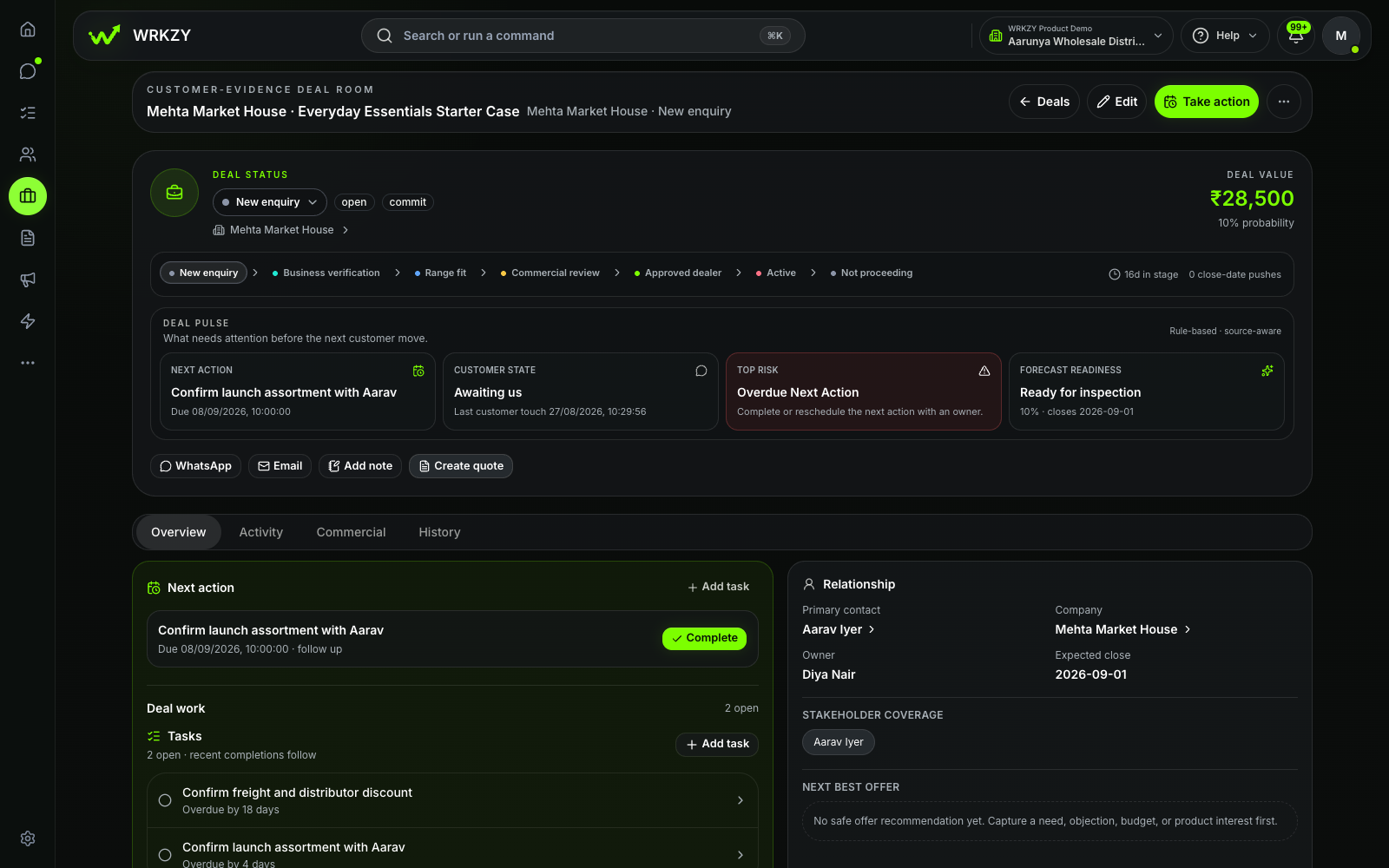 Current productDeal pulse, ownership and next actionOpen larger ↗
Evidence boundaryThis capture shows one seeded deal record and its visible workflow state; it does not prove that the deal will close.
The deal records the team’s current commercial judgment; a linked quote records the exact buyer-facing offer and its response history. Keep that distinction intact when you move a deal through a pipeline.
No next action, no healthy deal
An active deal without a named owner and due action is not operational merely because it occupies the correct column. After movement, mark one deal-linked task as the next action, with a clear title, assignee, due time, priority, and reminder where needed. Use comments for progress or blockers and notes for durable context.
Use each Deals view for a distinct operating question:
- Work for commitments such as Needs action, Awaiting customer, Overdue, Unassigned, Quote pending, Stalled, and Data gaps;
- Board for stage flow and individual movement;
- Table for dense comparison and reviewed bulk changes; and
- Forecast for period, owner, probability, category, currency, target, and coverage inspection.
None replaces the Deal Room when a consequential change needs customer and commercial context. For the task-level practice, use Track deal follow-ups, tasks, and comments.
Check whether the pipeline is becoming more accurate
Pipeline health is not the number of deals that move forward. A fast-moving pipeline can still contain weak evidence, missing ownership, and repeatedly pushed close dates.
Review a sample weekly and track:
- the share of active deals with one accountable owner;
- the share with one marked next action and a usable due time;
- deals beyond their stage’s stale-after threshold;
- no-follow-up, missing-probability, and overdue-close signals;
- close-date pushes and time in stage;
- blocked moves caused by missing required fields or approvals; and
- sampled stage transitions where the source evidence, exit decision, and history agree.
Read these as prompts, not verdicts. A blocked move can mean the control worked; a long stage can reflect a legitimate buying process. Open the deal before deciding whether to coach the owner, repair the definition, or close honestly.
Prove the design with one representative deal
Choose a recurring selling motion and follow one opportunity from verified enquiry to a closed outcome. At every stage, ask the team to explain the evidence, owner, exit decision, and next action. Then inspect whether Work, Board, Table, Forecast, the Deal Room, and history describe the same commercial reality.
The companion guide on building a sales follow-up system shows how to carry that evidence into daily ownership, dated actions, and recorded outcomes.
Explore WRKZY Pipelines to see how the stages work, then use the configuration guide to turn one approved sales process into a testable pipeline.