

Aarav’s message fits on one phone screen: can you supply a bulk rollout kit, implementation and team enablement before the next store opens?
A quick reply is easy. A reliable quote is not. Maya has to identify the buyer, confirm the scope, use current prices, resolve approval, send the right version and know what should happen after Aarav responds. Put those decisions in separate messages and spreadsheets and the team can send a beautiful quote while still losing the customer outcome.
We will follow one composite offer—Q-2026-014, Revision 2, for ₹1,85,000—from Aarav’s WhatsApp enquiry to a verified response. The names and amount make the steps easier to follow; the operating chain is the real subject.

A quote is a decision, not a PDF
It is tempting to treat quoting as document generation: collect line items, make a PDF and send it. That model stops too early. The customer is making a decision, and the seller needs to know that the right offer reached the intended buyer, received a clear response and created owned follow-through.
The job is complete only when:
The buyer can understand the current offer, ask a question, request a governed change, decline, or accept—and the team can see which version, amount, and next owner that response belongs to.
That outcome needs a connected sequence. Each state should have its own evidence instead of borrowing certainty from the state before it.
- 01Customer requestSourced enquiry and responsible owner
- 02Reviewed scopeCatalog items, quantities, price, and currency
- 03Controlled quoteRecipient, terms, validity, and approval
- 04Buyer decisionVerified review and recorded response
- 05Follow-throughNamed owner and next commercial action
| State | Operating question | Evidence to inspect |
|---|---|---|
| Enquiry | What is the customer actually asking for? | Source conversation and verified customer context |
| Draft | Does the offer match that request? | Buyer, catalog lines, quantities, totals, terms, owner |
| Approval | Did an authorized person review this exact commercial state? | Approval status, reviewed snapshot, and decision reason |
| Published and sent | Which current revision was made available, and through which channel? | Quote lineage, recipient, channel, and delivery history |
| Buyer response | What did the buyer choose against which offer? | Verification event, selection, revision, amount, response |
| Follow-through | Who owns the work created by that decision? | Linked deal, handoff, owner, due action, and current state |
Begin where the request arrived
Maya begins in the customer work that created the request. She confirms Aarav, Mehta Stores, the relevant conversation, the open deal, the intended currency, and the latest commercial question. She also searches for an existing draft or revision before creating another offer.
This first step prevents two common failures. The first is quoting the right product to the wrong customer context. The second is creating competing “latest” versions because somebody started from a blank document instead of the current commercial record.
In WRKZY, Customer Context connects the contact, company, conversation, and open commercial work needed for the next decision. Catalog supplies reviewed product and service records. Quotes turns that material into a buyer-specific offer with its own validity, terms, approval, revision, delivery, and response history.
The boundary matters: the conversation explains the need; the catalog defines reusable offers; the deal carries working commercial scope; and the quote records what this buyer can act on now.
Make the offer easy for the buyer to understand
For Q-2026-014, Maya selects the reviewed rollout kit, implementation service, and enablement service. She then checks the fields that make the offer specific to Aarav’s decision:
- buyer and company;
- linked deal and accountable owner;
- currency, quantities, unit prices, discounts, tax, and total;
- packages or optional lines, including any buyer-editable ranges;
- validity, payment terms, delivery assumptions, and exclusions; and
- buyer-facing branding, notes, and section visibility.
The catalog default is a starting input, not permission to skip judgment. A current product price may still be wrong for the buyer’s approved segment, quantity, currency, or effective period. The team should understand any difference between the quote total and the linked deal rather than forcing the two records to match silently.
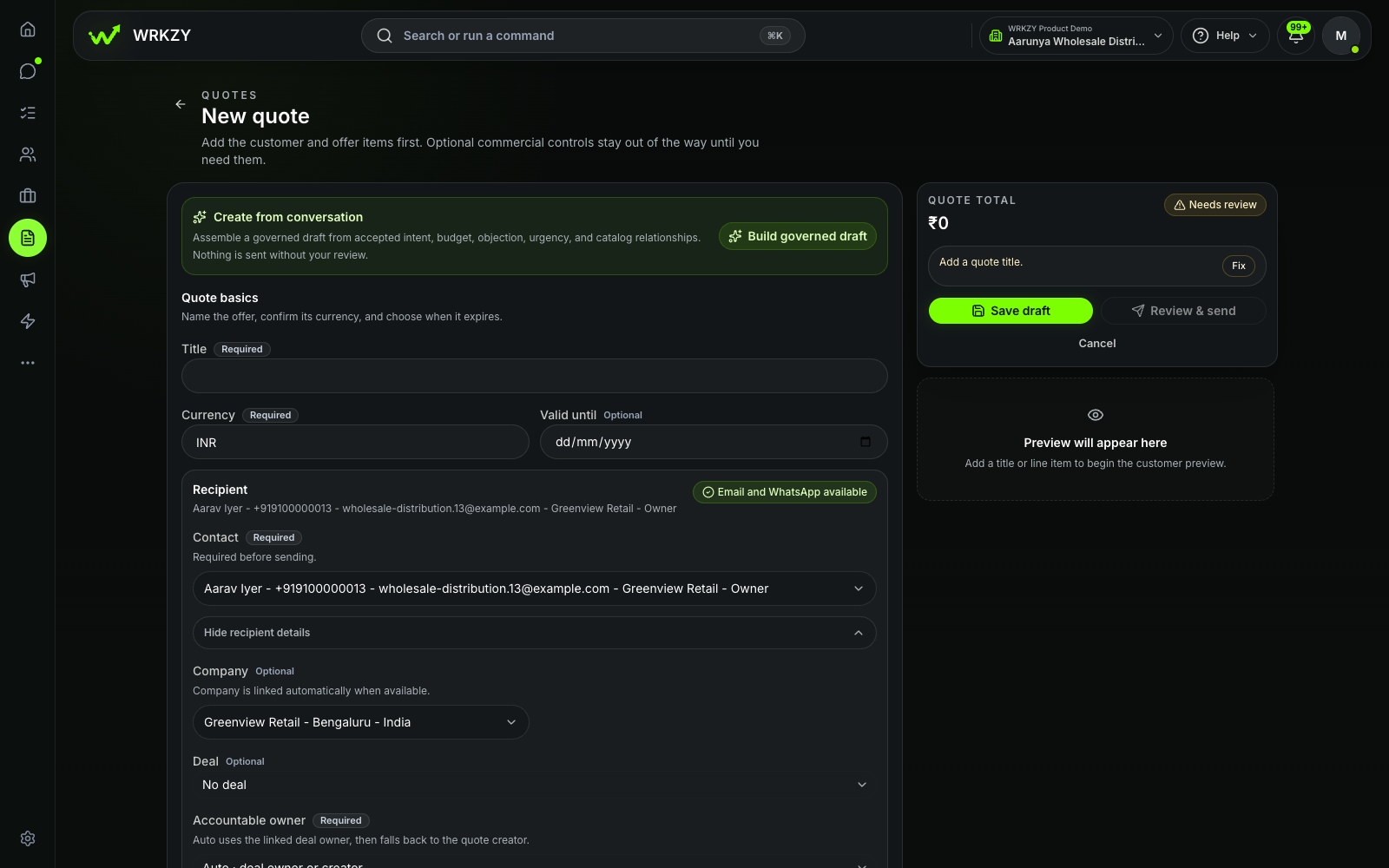 Current productGoverned quote draft with buyer contextOpen larger ↗
Evidence boundaryThis capture shows an unsaved draft and available controls; it does not show that a quote was saved, sent or accepted.
Use the customer quote creation and review guide as the pre-send operating checklist. Reopen the saved draft and confirm its status, totals, validity, approval state, linked context, preview, and follow-up owner.
Approval, sending and delivery are different steps
These states are related, but none proves the next:
- Approved means an authorized decision was recorded for the reviewed snapshot. It does not mean the quote was published or sent.
- Published means controlled buyer access was created or refreshed. It does not mean the provider delivered the message.
- Sent means a provider send was recorded. It does not prove delivery, viewing, or agreement.
- Delivered is provider-reported delivery. It does not prove that the buyer understood or accepted the offer.
- Viewed means the secure quote page was opened. It does not identify every viewer or prove purchase intent.
- Accepted means the buyer submitted a governed response against the offer. It does not mean the downstream deal, invoicing, or fulfilment is complete.
For Acme Retail, an approver reviews the exact Q-2026-014 snapshot: buyer, scope, totals, discount, tax, validity, and terms. If the decision is rejected, the reason should tell Maya what to change. The team does not temporarily change value or scope to avoid an approval rule.
When the quote is ready, Maya uses the supported email or WhatsApp share flow rather than copying a secure URL into an unrelated conversation. That keeps the intended recipient, provider attempt, attachment behavior, status, and timeline connected. The quote sharing guide explains the channel preflight, including the WhatsApp customer-service window and approved-template paths.
Design the buyer’s side of the decision
The secure buyer page can present the approved brand, current quote number, validity, packages, line items, quantities, prices, tax, total, notes, and terms without giving the buyer access to the internal workspace. Within the seller’s pre-approved rules, a buyer may compare packages, select optional lines, or adjust allowed quantities before responding.
Before a consequential response, WRKZY can ask the buyer to verify through the configured email or WhatsApp path. The response can capture the buyer-provided name, role, authority confirmation, selection, revision, and amount.
The buyer can accept, decline, ask a question, or request a structured change to product, price, scope, terms, or timing. Those are different operational outcomes. A question needs a response owner. A change request needs a new reviewable revision. A decline should inform an honest deal update. Acceptance creates a handoff rather than ending the workflow.
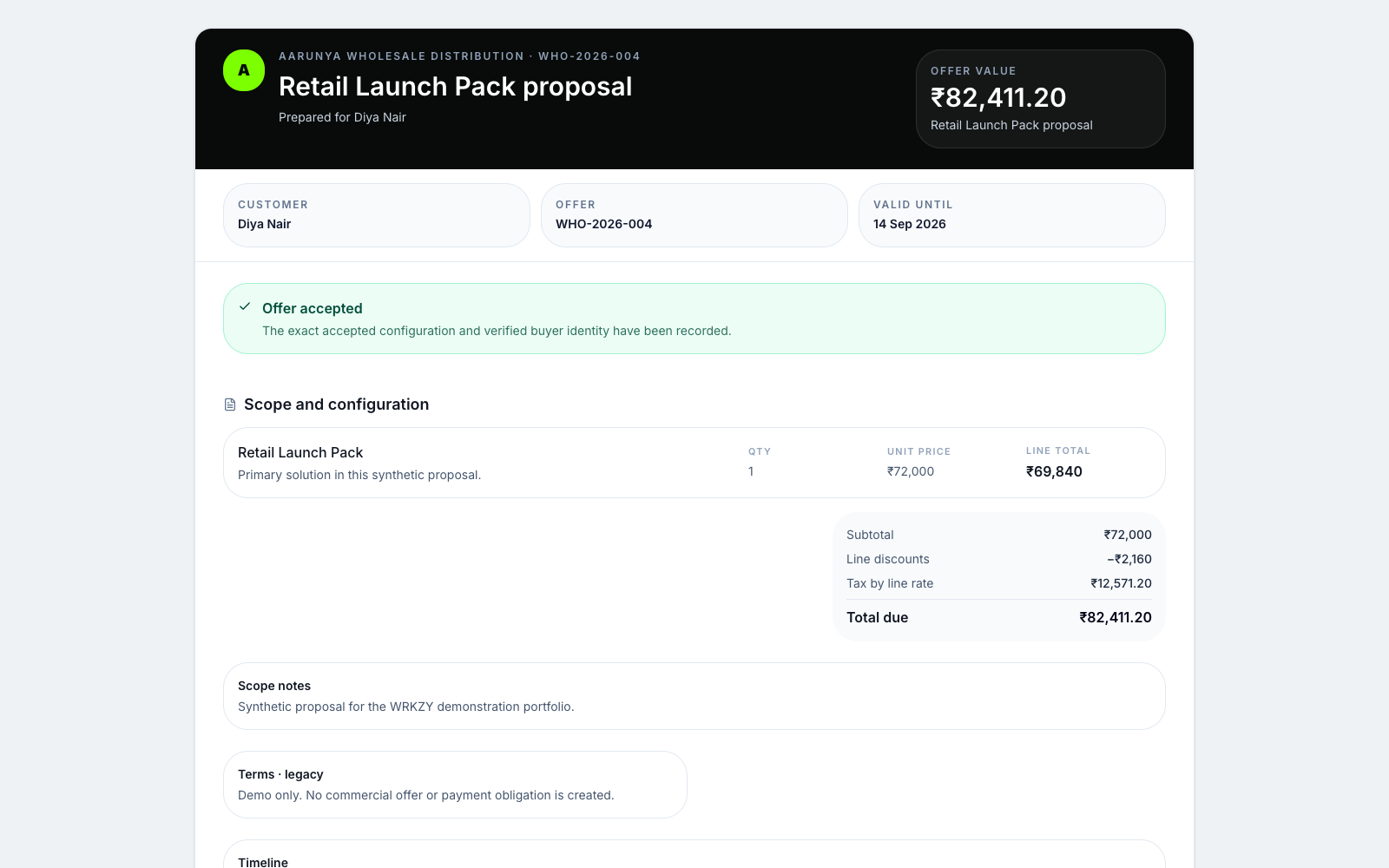 Current productAccepted customer-facing quoteOpen larger ↗
Evidence boundaryThis capture shows one seeded accepted proposal; it does not establish payment, fulfilment or universal acceptance outcomes.
An active current revision should make available actions clear. An expired, voided, archived, or superseded quote should explain that it is no longer actionable and direct the buyer to the current path. The public state is part of the decision experience, not decoration around the PDF.
Create a new version instead of rewriting the old quote
Suppose Aarav asks to move the start date and reduce an eligible quantity. Maya should not edit the sent offer. She creates a revision in the same lineage, reviews what was added, changed, or removed, recalculates totals and tax, and repeats approval when the new state crosses the workspace’s rules.
The older offer remains evidence of what the buyer could previously act on. The new revision becomes the current path where applicable. This is why “Revision 2” is operationally meaningful: it lets the team answer which terms were offered, which response belongs to them, and what changed next.
The approval and revision guide covers this workflow in detail.
What happens after the customer accepts?
When Aarav accepts Revision 2, the recorded response preserves the accepted amount and currency. Maya then checks the selected package or quantities, verification evidence, linked conversation, contact, and deal. She reconciles the accepted offer with the deal deliberately; recording reconciliation does not silently change deal value, currency, status, or stage.
The next action might be an implementation handoff, an order or billing step in the organization’s approved system, or a customer confirmation. Whatever the process, name one owner and a due point. “Quote accepted” is a commercial decision, not proof that every downstream commitment is complete.
Measure the whole journey, not only the conversion rate
Review a small sample of quotes each month and track signals the team can improve:
- time from the enquiry to a named owner;
- time from complete scope to approval-ready draft;
- drafts blocked by missing buyer, terms, prices, or approval;
- delivery failures and repeated sends before root-cause correction;
- questions or change requests without an owner or due action;
- revision count and the reason for each material change; and
- time from verified acceptance to the first owned downstream action.
Do not treat sends, views, or acceptance rate alone as proof of a good workflow. A fast acceptance built on the wrong scope is not success. The goal is a decision the buyer can understand and a team can carry forward without reconstructing the commercial history.
If you are comparing tools rather than operating an existing workflow, use the 10-capability quotation software matrix to test buyer context, approvals, versions, delivery, and follow-through.
For your next offer, test the WRKZY quote workflow from draft to verified buyer response. Start with the exact customer request, inspect every state separately, and finish only when the resulting work has a visible owner.