

The buyer did not disappear. The team simply stopped creating reasons to continue the conversation.
On Monday, she asked for a revised scope. On Tuesday, the salesperson sent it. On Thursday, the manager asked whether she had responded. “Not yet—I’ll follow up,” came the answer. The following week, the deal was still open, the next action still lived in somebody’s head and the pipeline still suggested progress.
A dependable sales follow-up system prevents that drift. It turns every qualified opportunity into a chain of explicit commitments: one owner, one next action, one due point and one recorded outcome. When an action is complete, the owner either creates the next one or closes the loop.
The operating loop
The system has five parts:
- Capture the customer signal.
- Qualify whether it deserves commercial attention.
- Assign one accountable owner.
- Date the next action.
- Record the outcome, then repeat or close.
This is a loop, not a sequence that ends when a proposal is sent. A buyer’s question, a site visit, a revised quotation and a verbal delay each create a new decision about what should happen next.
- 01Capture the signalKeep the source and customer need→
- 02Qualify the workRecord why it deserves attention→
- 03Name one ownerMake responsibility unambiguous→
- 04Date the actionWrite what happens next and when→
- 05Record the outcomeRepeat the loop or close it honestly
1. Capture the signal where it arrives
A lead may begin through WhatsApp, email, a referral, a form, a phone call or a meeting. The source matters because the original words often contain useful context. Capture enough to let another person understand the request:
- contact and company;
- source and time;
- product, service or problem mentioned;
- location or delivery context where relevant;
- stated timing; and
- any commitment the team has already made.
Do not begin by demanding every possible field. At this point the business is preserving the signal, not completing a census.
For WhatsApp-led teams, the lead-handling discipline starts inside the conversation. The handoff into a sales record should not require pasting the whole chat into a note.
2. Qualify with a visible reason
Qualification answers whether the enquiry should become active sales work now. A simple rule can be enough:
- there is a real person or organisation;
- the need falls within the company’s offer;
- a plausible commercial next step exists; and
- somebody has agreed to own it.
“Interested” is too weak. Record the evidence: requested a site visit, asked for a 200-unit price, shared a technical drawing or confirmed a purchasing window.
If the enquiry is not qualified, record why. It may be outside the service area, too early, unreachable after agreed attempts or not a fit. A closed reason is better than a permanently open lead that makes the pipeline look larger than it is.
3. Assign one owner
Several people may contribute to a sale. Only one person should own its forward movement at a given time.
The owner is responsible for knowing:
- the current customer need;
- the latest meaningful event;
- the next action and due point;
- the internal dependency, if any; and
- the condition that would close or advance the deal.
Ownership is not the same as doing every task. A salesperson may need a technical colleague to visit the site and finance to approve a discount. The salesperson can remain accountable for making sure those contributions produce the promised customer response.
When ownership changes, record the handover and the next commitment. A reassigned name without context is not a handoff.
4. Write the next action so another person could execute it
Weak follow-ups describe a feeling: “check in,” “touch base,” “follow up next week.” Strong follow-ups name the action, purpose and timing.
Compare:
| Weak entry | Executable next action |
|---|---|
| Follow up | Rohan to call Priya by 4 pm Tuesday to confirm whether the revised 50-unit option meets the budget |
| Send details | Meera to email the fire-rating certificate before Friday’s consultant review |
| Check quote | Arjun to confirm procurement comments on Quote Q-184 by 11 am Thursday |
| Site visit | Nisha to schedule the Pune site measurement with the contractor for the week of 12 October |
The date must reflect a real business event: a promised response, a buyer review, a quotation expiry or an internal dependency. Arbitrary reminders teach the team to snooze tasks.
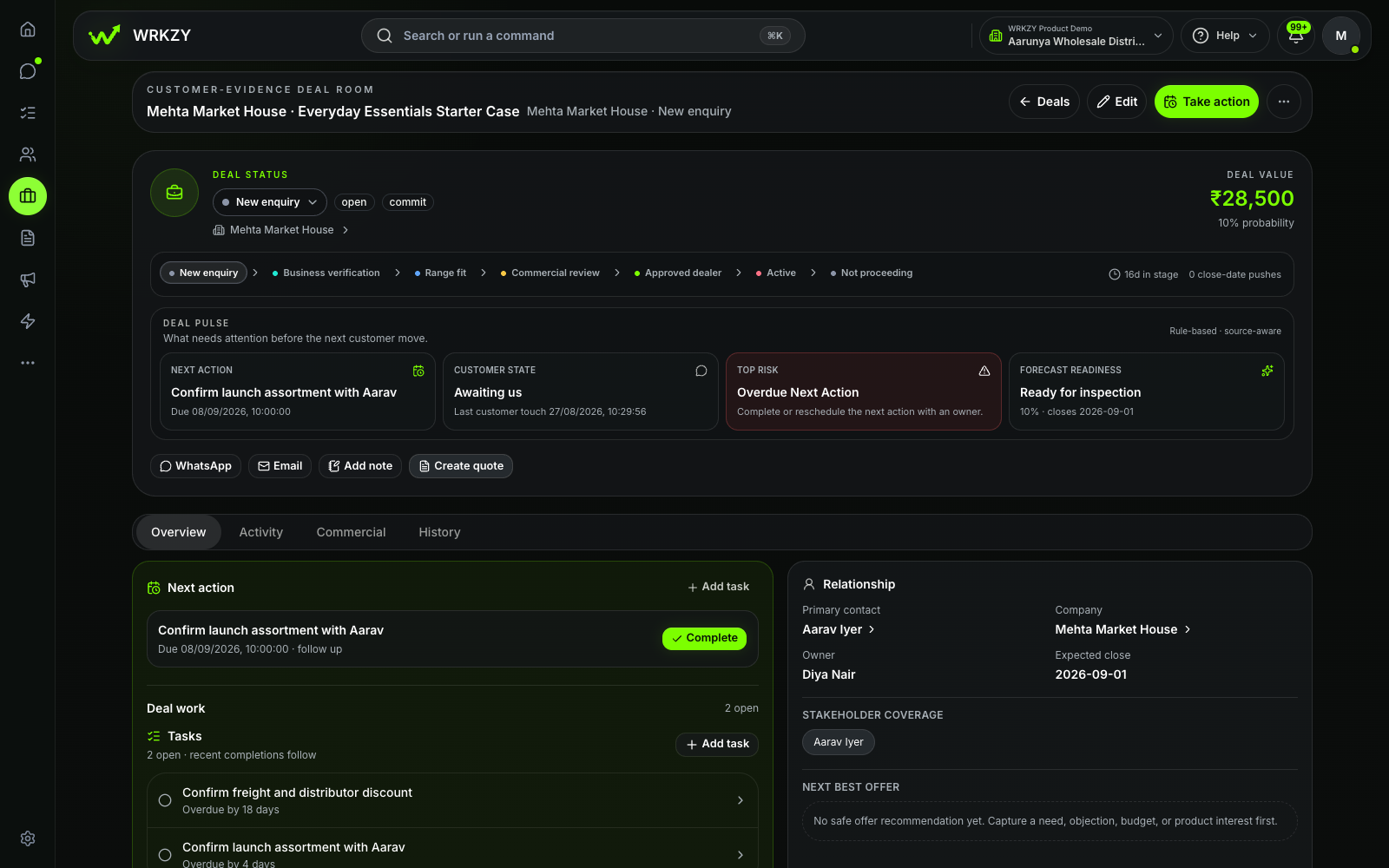 Current productDeal pulse, ownership and next actionOpen larger ↗
Evidence boundaryThis capture shows one seeded deal record and its visible workflow state; it does not prove that the deal will close.
5. Record the outcome before creating the next task
A completed task says an action occurred. It does not say what changed.
After each meaningful follow-up, capture the result in one or two precise lines:
- buyer approved the technical scope and requested a revised payment schedule;
- no answer after the second agreed attempt; retry on the buyer’s stated return date;
- procurement paused the project until the January budget cycle; or
- quote declined because delivery time exceeded the required date.
Then decide: create the next action, change the stage or close the opportunity. Never close a task merely to clean up an overdue list while leaving the underlying deal untouched.
Design pipeline stages around evidence
Follow-up becomes easier when stages describe what is known, not how optimistic the salesperson feels.
A simple pipeline might use evidence such as:
- Qualified: need and responsible contact confirmed;
- Discovery complete: requirements and decision process recorded;
- Offer in review: current quotation delivered through the agreed path;
- Decision pending: buyer has the information needed and a review point is known;
- Won: the business’s defined acceptance evidence is recorded; or
- Lost/closed: reason and final state recorded.
The exact labels can differ. The principle is durable: a stage change should point to evidence. Read how to design pipeline stages around evidence before adding more stages.
Set a daily and weekly rhythm
Software can surface work, but management rhythm keeps it credible.
Every morning: work the exception queue
Each owner reviews:
- actions due today;
- overdue actions;
- unassigned qualified enquiries;
- customer replies awaiting a response; and
- deals with no future action.
The list should lead directly to work. If employees need to prepare a second list for the meeting, the system of record is not being used.
At the end of the day: close the loop
Record outcomes for completed actions and set the next commitment. Reassign anything that cannot wait for an absent owner.
Once a week: inspect the process, not just the forecast
The manager reviews a small sample of stalled deals. Ask:
- Is the stage supported by evidence?
- Is the next action specific and dated?
- Is the customer waiting on us, or are we waiting on the customer?
- Has a repeated failure appeared—slow approvals, missing technical details, unclear quotations?
- Should the deal remain active?
This review improves the operating system. A meeting that only asks salespeople to defend a number usually improves presentation, not follow-through.
Use automation for control, not imitation
Useful automations are narrow and inspectable. They may alert a manager when a qualified lead remains unassigned, remind an owner before a promised date or flag an open deal with no next action.
Automated customer messages need more care. Timing, consent, channel rules and the customer’s actual situation matter. A generic sequence can continue after the buyer has already said no, asked a complex question or raised a complaint.
Keep judgment-heavy moments human. Decide what to automate and what to keep human by considering consequence, ambiguity and reversibility.
Measure whether the system is healthy
Do not start with a leaderboard of calls or messages. Activity can rise while customer work deteriorates.
Use a small set of operating measures:
- percentage of qualified leads with an owner;
- percentage of active deals with a future dated action;
- overdue actions by age, not merely count;
- time from customer reply to owner response;
- deals remaining in one stage beyond the expected review point; and
- closed outcomes with a usable reason.
These measures do not prove revenue impact by themselves. They show whether the follow-up process is being operated as designed.
Begin with the next 20 opportunities
Do not wait to clean the entire database. Choose the next 20 qualified opportunities. For each one, confirm the customer, current stage evidence, owner, next action, due point and close condition. Review the list every day for two weeks.
The habit will reveal where your process breaks: unclear ownership, slow internal approvals, weak qualification or tasks that cannot be executed. Fix those causes before adding more reminders.
See how WRKZY keeps deals, tasks, conversations and next actions connected.