

The weekend campaign looks healthy. Delivery is strong and a customer has replied: “Can someone confirm whether Tuesday’s installation is still on?” The dashboard now shows one response. Success—at least from a distance.
Up close, the customer is still waiting. Does the service team own the answer? Should the campaign manager route it? Has anybody accepted responsibility for replying before Tuesday?
A meaningful response creates value only when it returns to customer work with its source, owner and next action intact. The return path should be designed before launch, not improvised after the first important reply lands.

A reply is only the beginning
Campaign reporting and customer follow-through answer different questions. Delivery evidence tells the team what the provider and recipient endpoint reported. Engagement signals show a channel-specific interaction. A reply tells the team that a response reached the linked workflow. None of those states, by itself, proves that somebody has understood the request or completed the customer outcome.
Keep the states distinct:
| State | What it can establish | What remains open |
|---|---|---|
| Sent | Provider submission was recorded | Delivery, customer attention, and customer progress |
| Delivered | The provider reported arrival at the recipient endpoint | Whether the recipient read, understood, or acted |
| Read, opened, or clicked | A channel-specific engagement signal, subject to measurement limits | Customer intent and the next operating decision |
| Replied | A response reached the linked campaign workflow | Meaning, ownership, timing, and required context |
| Owned | A named teammate and a specific next action are visible | Completion of the underlying customer request |
| Completed | The source record shows the decision, action, or resolved outcome | Any new commitment created by that result |
“Owned” and “Completed” in this table are operating checks, not provider delivery events. Treating them as separate stages prevents a response rate from hiding unfinished customer work.
- 01AudienceEligible and expected→
- 02ReviewMessage, sender, and reply path→
- 03SendApproved WhatsApp or email route↓
- 04EvidenceDelivery and channel-specific signals←
- 05ResponseMeaningful reply stays contextual←
- 06Clear follow-upTeammate, due action, and result
Decide who handles each type of reply before launch
The reply path is part of campaign design. Before testing or scheduling, name the person or team responsible for each signal the campaign may create. “Marketing will monitor it” is too vague when a reply asks for a quote, raises a delivery exception, or changes communication eligibility.
Use a small response contract:
| Signal after launch | First responsible role | Primary evidence | Completion check |
|---|---|---|---|
| Delivery failure or skipped recipient | Campaign operations owner | Recipient reason on the source campaign | Cause understood; supported recovery used only where appropriate |
| Unsubscribe or stop request | Consent or campaign owner | Channel consent, unsubscribe, or eligibility state | Future eligibility reflects the request; suppression is checked where applicable |
| Product question or service issue | Responsible customer team | Linked Inbox conversation and customer record | Reply or resolution recorded with no hidden commitment |
| Quote, renewal, or commercial request | Authorized commercial owner | Customer context plus linked deal or quote | Decision and next customer-facing action are visible |
| Campaign learning review | Campaign owner | Outcome snapshot, responders, and exceptions | Declared result reviewed after the chosen window |
Also name the monitoring window and backup owner. A campaign scheduled for an hour when nobody can handle replies turns a successful send into a service delay. Confirm sender readiness, consent or other approved eligibility, the final recipient snapshot, content, schedule, timezone, and the actual reply route before launch.
WhatsApp and email are available in WRKZY today, but their evidence is not interchangeable. WhatsApp delivery and read states follow provider rules. Email can expose delivery, opens, clicks, replies, bounces, unsubscribes, and suppression where supported. Do not compare an email open with a WhatsApp read as though they were the same measurement.
Provider rules also change independently of WRKZY. Before a governed send, re-check the WhatsApp Business Messaging Policy and, when Gmail recipients are in scope, Google’s current email sender guidelines.
Look beyond the campaign summary
After launch, open the campaign before deciding what happened. During Sending, totals may still change. A summary card or notification is a route into the source record, not the final evidence.
Use the campaign record to confirm status, final recipient totals, delivery and engagement evidence, issue states, responders, and the declared outcome window. For a failed or skipped recipient, read the reason and group similar exceptions before changing anything. Retry only failed eligible recipients through the supported action after the root cause is understood; do not resend to recipients who already succeeded.
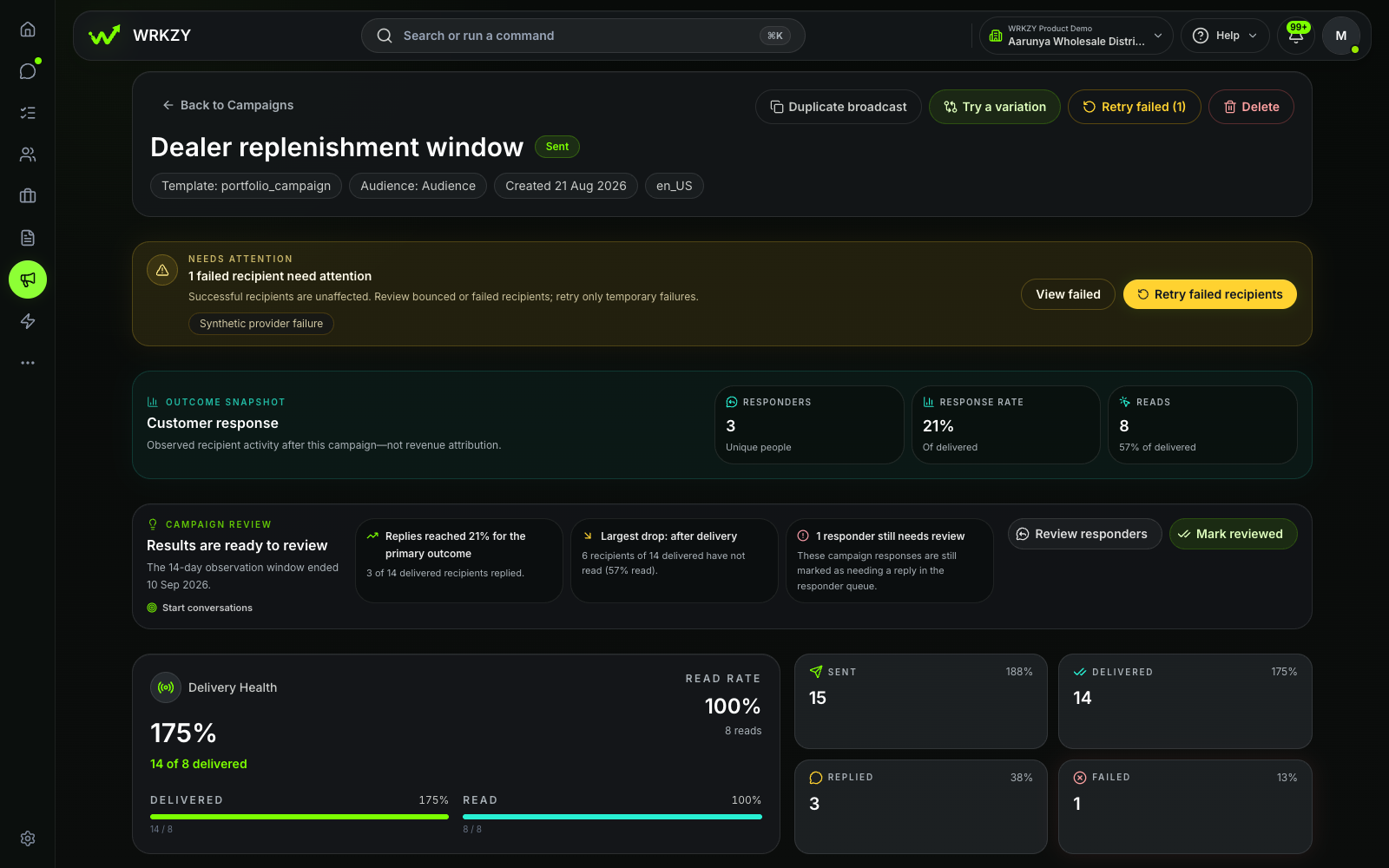 Current productCampaign delivery and response evidenceOpen larger ↗
Evidence boundaryThis seeded demo record illustrates the results interface; its synthetic counts and rates are not performance benchmarks.
The visible campaign health signals help a campaign owner find work. They do not replace the recipient record, linked conversation, or customer context needed to decide what that work means.
Turn each useful reply into a follow-up
Now consider a commercial reply asking for a quote. The workflow is more than “mark one reply.” It is a short sequence another authorized teammate can reconstruct:
- Open the responder from the source campaign.
- Read the actual response and confirm the customer identity.
- Continue from the linked Inbox conversation or customer record rather than copying the reply into a detached note.
- Inspect current relationship context, including an existing deal or quote when it changes the decision.
- Assign the response to the teammate who has accepted the next decision.
- Record a concrete next action and due time on the appropriate workflow record.
- Update the response or follow-up state only when the continuation path is visible.
- Return to the campaign review after the declared window and inspect unresolved responders and exceptions.
Write the next action as verb + object + dependency + time: “Prepare the bulk-order quote after finance confirms the approved discount; today 15:00.” “Follow up with customer” does not say what must be produced or which dependency can block it.
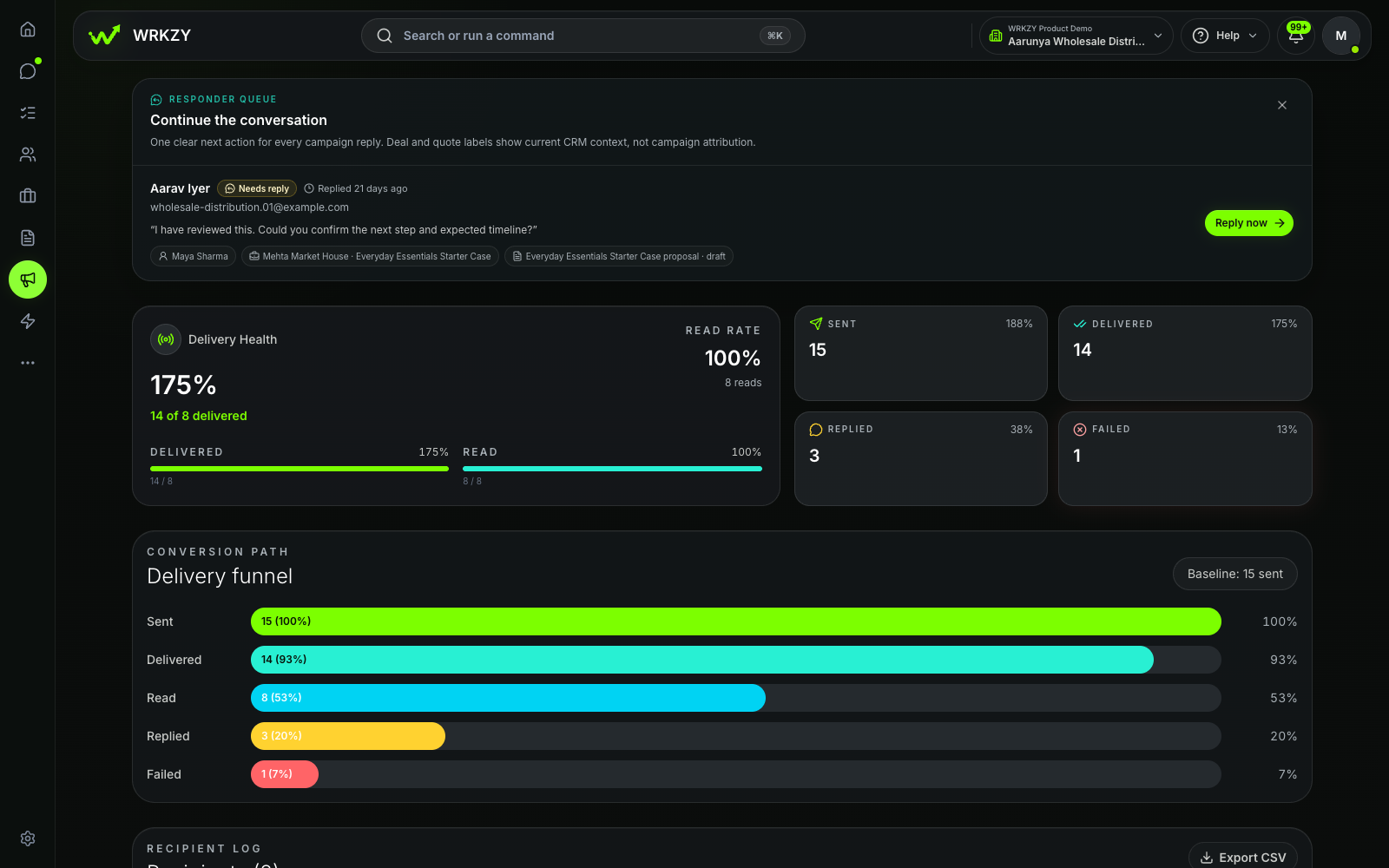 Current productResponder, reply and linked commercial workOpen larger ↗
Evidence boundaryThis capture shows one seeded responder record; it does not prove automatic qualification or conversion of every reply.
The responder evidence is useful because it connects one reply to one accountable continuation. It does not imply that every response becomes a deal, that the campaign caused the existing opportunity, or that marking the response handled completes the commercial work.
Different replies need different follow-ups
Not every reply should enter the same sales queue. Define a narrow treatment for the signals the team actually expects.
- A clear customer question should continue in the linked conversation with a responsible owner.
- A quote or renewal request should connect to the relevant commercial record and authorized decision-maker.
- A complaint or service problem should move to the team that can resolve the underlying outcome, not remain with the campaign creator by default.
- An unsubscribe or stop request should update the appropriate channel consent, unsubscribe, or eligibility state before future outreach, with suppression applied where that governed mechanism is relevant.
- An automatic reply, ambiguous response, or unrelated message should be reviewed before it is treated as intent.
- A delivery failure should remain an exception investigation until the cause and safe recovery path are known.
Avoid creating a new team inbox for every campaign. Use a campaign for governed outreach, the Inbox for individual customer conversations, and a team inbox only when a durable responsibility, access, routing, or service-policy boundary genuinely differs. The responder can retain campaign source while the customer work continues on the surface that owns the outcome.
Track the reply through to the customer result
Responder follow-through should improve the customer record and the campaign review.
On the customer side, record the decision, message, task, deal, quote, or follow-up where the next teammate will look. On the campaign side, review responders, overdue actions, delivery exceptions, and the declared primary outcome after the chosen window. A campaign can be Sent while its customer work remains open.
Do not optimize from delivery or opens alone. A small campaign with two well-owned customer requests may create more useful progress than a large campaign with high engagement and no continuation path. Conversely, a high reply count can expose an unclear promise or an operational burden the team was not ready to carry.
For one recurring campaign type, review a small set of operating measures:
- median time from meaningful response to a named owner;
- percentage of meaningful responders with an accepted next action;
- age of unassigned responses and overdue follow-ups;
- unresolved delivery or channel-eligibility exceptions, including applicable suppression, after the review window;
- responses that required a side conversation before another teammate could act; and
- completion of the declared customer outcome, kept separate from channel engagement.
Choose two or three measures that match the campaign’s purpose. A fast assignment is not success if the owner lacks access, authority, or enough context to finish the work.
Before the next send, follow one responder from campaign source to customer outcome. If the team can see who replied, what they need, who owns the next decision, and where completion will appear, the campaign has a working return path.
The broader WhatsApp CRM guide explains how that response fits into customer context, ownership, and downstream commercial work.
Explore WRKZY Campaigns to see how approved WhatsApp and email outreach connects delivery evidence, responder follow-through, and outcome review.