

A customer asks for a rollout change. Sales knows why it matters. Implementation knows what is possible. Finance knows what the quote covers. Everyone is copied, so everyone assumes the handoff has happened.
On Monday, the customer asks for an update. The team learns an expensive little lesson: everybody knowing about the work is not the same as somebody owning it.
A handoff is complete only when context and responsibility move together. This playbook uses a compact contract that sales, support, onboarding, service, and commercial teams can apply without creating another meeting.

Hand over an outcome, not a notification
Most handoffs begin with a destination: “Send it to implementation” or “Ask finance.” Start with the decision or action the receiving person must carry.
“Please take a look” is not an outcome. “Confirm whether the current quote covers the requested rollout and reply by Thursday” is. One moves a message; the other moves the work.
Write the outcome so the receiver can recognize completion. A good handoff states:
- the customer need or question;
- the decision or action required;
- the person who owns it now;
- the expected timing or service commitment; and
- the visible state that marks completion.
Give the short version—and the source
The receiver needs enough context to act without rereading every interaction. A useful summary explains the customer’s current intent, the important history, any commitment already made, and the records that govern the next decision.
Then link the source conversation, customer record, deal, quote, or workflow-linked task. The summary gives the receiver a way in; the source gives them a way to verify. When information changes, connected context is easier to trust than a copied note.
In WRKZY, keep stable customer facts on the contact or company, time-ordered interaction in the conversation or timeline, and commercial decisions with the deal or quote they affect. Put a due commitment in a follow-up, Next time, or deal-linked task rather than leaving it only in an internal note.
The six details every handoff needs
For important work, use the six-part contract below as the shared operating history. Each part answers a question the receiving person would otherwise need to reconstruct.
- 01Customer outcomeConfirm the revised rollout
- 02Current stateQuote covers the original date
- 03Open pointPricing impact needs review
- 04New ownerPriya owns the check
- 05Next actionConfirm by Thursday, 3 p.m.
- 06Return pathImplementation sends the reply
Copy this six-line brief into the working note or handoff message before responsibility changes:
Customer outcome:
Current state and source:
Open point:
Current owner:
Next action and due time:
Return path:
Here is what it can sound like in practice:
Acme wants to move the pilot to 14 August. The current quote covers the original date only. Priya owns the commercial check; she will confirm the pricing impact by 3 p.m. Thursday. When the quote is approved, the request returns to the implementation owner for the customer reply.
That note carries an outcome, a current state, an open point, a new owner, a next action, and a return path. Before responsibility changes, the receiver can ask for a missing source, authority, or due time.
Where the handoff lives in WRKZY
The contract does not require a separate six-field object. It lives across the source record, visible owner, due work, and concise internal context already used to carry the customer outcome.
| Contract part | WRKZY surface | What to record |
|---|---|---|
| Customer outcome | Conversation or linked deal or quote | The result or decision the customer is waiting for |
| Current state and source | Conversation, customer timeline, deal, or quote | Verified facts, current status, and the record that supports them |
| Open point | Internal note, follow-up, or workflow-linked task | The exact question, dependency, or exception preventing completion |
| Current owner | Team-inbox route plus the conversation, deal, or task assignee | The responsible team and the one person carrying the next decision |
| Next action | Next time, follow-up, or deal-linked task | Verb, object, dependency, and due time |
| Return path | Internal note followed by reassignment or a status update | Who resumes responsibility and which visible state triggers the return |
The team inbox establishes group responsibility; individual assignment establishes who must move the decision. See the WRKZY Inbox for shared routing and ownership, and see Customer Context for the records a receiving teammate can inspect before acting.
Automate routine handoffs; confirm important ones
Routine work can move through an agreed queue. Workspace owners can review the route, workload, and unassigned work before changing the setup.
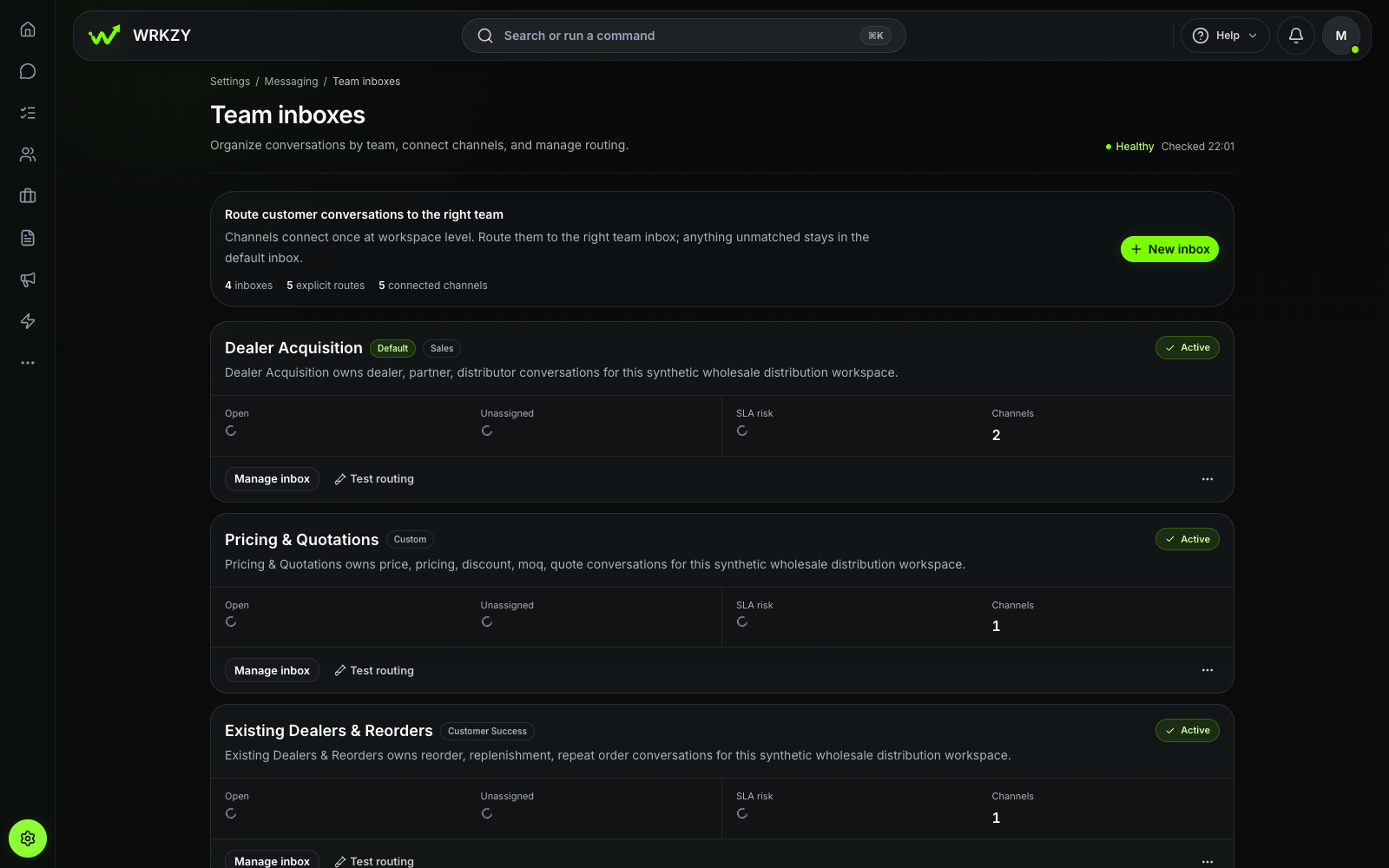 Current productTeam inbox routing and workload healthOpen larger ↗
Evidence boundaryThis capture shows the configured synthetic team inbox at the recorded commit; routing results depend on each workspace setup.
Use explicit acceptance when a handoff changes a price, deadline, customer commitment, permission, provider configuration, data-handling decision, or responsibility between teams. In this playbook, acceptance is an operating discipline—not a claim that every handoff has a dedicated Accept button. Confirm that the receiver has the authority and access to act, then record the accepted owner and due next action in WRKZY.
Record the outcome where everyone can see it
The final step is not sending the answer. It is updating the shared record so the next person can understand what happened.
Record the decision, the customer-facing action, any new commitment, the current owner, and the state of the original request. If responsibility returns to the first team, return it with the new next action rather than relying on a private notification.
This is the difference between “finance replied” and “the customer outcome moved forward.”
When the handoff fails, find the missing detail
When a handoff fails, it is tempting to add another meeting, field, or reminder. First identify which part of the contract was missing. Was the outcome unclear? Was the decisive context unavailable? Did the owner lack authority? Was the next action invisible? Did the return path disappear?
Fix that part of the workflow. Add structure only when it prevents the same failure from recurring.
For one recurring handoff, review these measures before and after the change:
- time from the team route to a named owner;
- age of active unassigned work;
- number of overdue next actions;
- handoffs per resolved customer outcome; and
- reopened or repeated work after the team believed the request was complete.
Do not turn this into a ceremony. The handoff works when the receiver knows what good looks like and the customer never has to coordinate your team for you.
If follow-up still depends on the previous owner remembering what happens next, build the capture-to-outcome sales follow-up loop before adding another meeting.
To put this model into practice, see how WRKZY routes shared customer work and keeps ownership visible.