

Open a busy customer record and it can look reassuringly complete: twelve custom fields, two years of conversations and notes from three teammates. Then somebody asks the only question that matters today—“Did the customer agree to a phased rollout?”—and the answer is buried in a message nobody knew to open.
That is the difference between having data and having context.
Useful customer context is the smallest reliable set of facts, history, permissions and open work that helps an authorized teammate make the next decision. It may sit across the contact and company relationship, verified WhatsApp and email identities, sourced conversations, owners, deals, quotes and follow-ups. It should not be flattened into one enormous note. The links between those records are part of the meaning.
When that context contains personal data, the ICO’s primary guidance on data minimisation provides a useful regulatory test: the data should be adequate and relevant for the stated purpose, and limited to what is necessary. Apply the law and guidance relevant to your own organization and customers.

Start with today’s question
Before adding another field, ask what a teammate should be able to decide after reading the record. Should they choose the right owner? Understand an unresolved request? Prepare a follow-up? Review an opportunity? Avoid asking the customer the same question twice?
Then identify the evidence needed for that decision. If a field or note does not support an active customer outcome, reporting requirement, permission, or durable business record, question why it belongs in the workspace.
Most teams do this in reverse: collect first, then hope the information becomes useful. Decision-led context starts with the work and makes every stored detail earn its place.
Suppose a teammate opens an account after the customer says a replacement has failed for the second time. They do not need every historical attribute first. They need the latest conversation, the original service promise, the unresolved request, the person handling it and the reply due today.
Separate facts, opinions and next steps
A reliable record separates what the customer said, what the team concluded, and what should happen next:
- Fact: the customer requested a revised rollout date in the latest conversation.
- Interpretation: the current timeline may not cover the requested onboarding sequence.
- Next action: the implementation owner will review capacity and reply by Thursday.
Combining all three into “Customer wants to delay—please review” makes later verification difficult. The next person cannot see whether the delay is confirmed, inferred, or merely being considered.
Clear labels make the record faster to scan and easier to challenge. They also give a teammate a reason to return to the source before making a consequential decision.
Give every fact a sensible home
A compact record is easier to trust when each fact has an operating home. In WRKZY, use the surface that will still make sense when another teammate takes over:
| Question | WRKZY surface | Keep visible |
|---|---|---|
| Who is this customer? | Contact, company relationship, and verified WhatsApp or email identity | Stable identity, company, lifecycle, and relationship owner |
| What happened? | The sourced conversation or Contact 360 timeline | Channel, participants, timestamp, and the customer’s actual words |
| What is in motion? | Linked deal, quote, task, or follow-up | Current state, material evidence, and unresolved point |
| Who is responsible now? | Relationship owner, team inbox, conversation assignee, or work owner | The role that owns this decision—not only the person who entered the data |
| What happens next? | A visible next action, task, or follow-up | Owner, due point, and the commitment being made |
Private Mail is a separate boundary. A CRM association can identify the relationship without exposing a private subject, participants, message body, or attachments to the team. Share only the narrow context that shared work genuinely requires.
Keep only the details your team needs
For many customer operations workflows, a useful starting set includes:
- stable customer and company identity;
- authorized contact routes and channel associations;
- current owner and responsible team;
- active relationship state or pipeline position;
- recent decisive conversation context;
- open commitments and next actions; and
- the important records linked to those commitments.
This is a starting point, not a universal schema. A service team may need entitlement or incident context. A sales team may need opportunity state and buying roles. Both should add custom fields only when the team knows who maintains them and which workflow uses them.
A field with no owner and no decision attached becomes stale decoration. Add enough of it and the reliable information becomes harder to find.
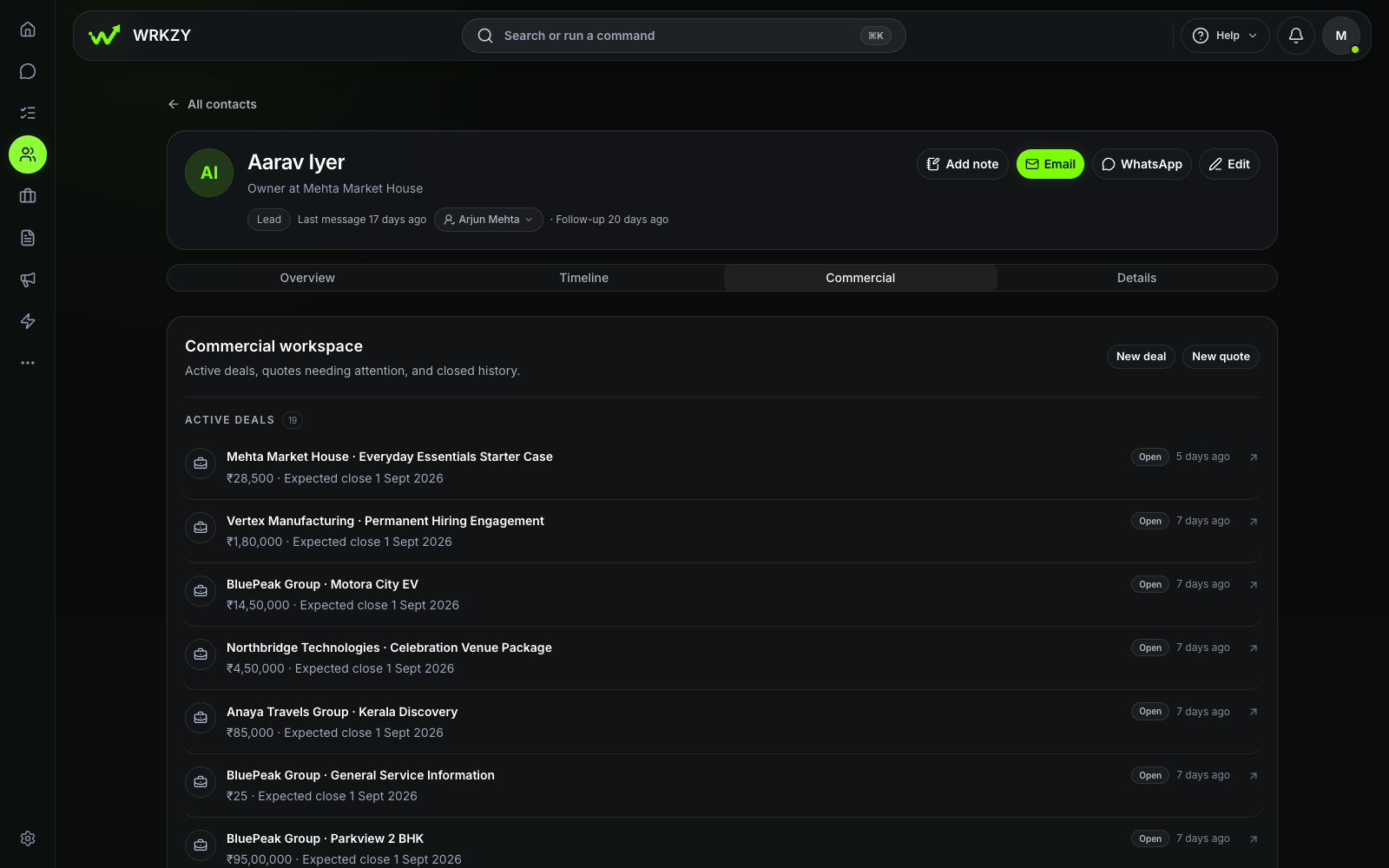 Current productCommercial context linked to one contactOpen larger ↗
Evidence boundaryThis capture shows one synthetic contact record and linked commercial context; it does not prove automatic data completeness.
Old context can be worse than no context
Ownership changes. Opportunities close. Permissions change. Old notes stop representing the relationship accurately. Useful context needs an ending as well as a beginning.
Decide which records are durable event history, which fields must stay current, and which information should be removed when it is no longer needed. Give people a clear route to correct customer identity, merge duplicates safely, and handle verified privacy or deletion requests.
The question is not only “Can we collect this?” It is also “Who will keep it accurate, who may use it, and when should it stop being here?”
Use three maintenance rules:
- preserve sourced events such as messages, approved quotes, and completed work according to the applicable records policy;
- update current state such as ownership, lifecycle, consent, open work, and due actions when the relationship changes; and
- correct or remove duplicate, contradictory, expired, or unnecessary information through the approved workspace and privacy process.
Could a teammate take over without calling you?
The best test is not whether every field is filled. Give an authorized teammate one real customer workflow without briefing them first and ask them to identify:
- the intended customer and company;
- the source of the decisive fact;
- the current relationship or commercial state;
- the unresolved point and responsible owner; and
- the next action and due point.
When they cannot, add or connect the missing evidence. When they find conflicting information, choose the authoritative source and remove the duplicate. When they can act without asking the previous owner, the context is doing its job.
Measure the practice with outcomes, not field completion. Sample real handoffs and track how many pass all five checks, how many commitments have no owner or due point, how many contradictory records need correction, and how often a teammate still needs an off-record explanation.
Good customer context sits between a contact card and a data warehouse: small enough to scan, rich enough to act on and easy enough to verify. When it works, neither the customer nor the team has to repeat the story.
Use this customer-record test alongside the 12-question small-business CRM scorecard when evaluating a new system.
Explore how Customer Context works in WRKZY, then use the implementation guide to apply the decision test to one real relationship.