

At 4:42 on Friday afternoon, a customer asks why Monday’s installation is still marked unconfirmed. The message lands in the shared inbox. The schedule lives in another system. The account owner is in a meeting, and the person who spoke to the installer is working from a private task list.
Nothing is technically broken. Every record exists. Yet the customer is waiting while the team reconstructs its own story.
That scramble is the case for customer operations: connecting the conversation, useful context, responsible person and next action so the team can carry one customer outcome from question to completion.

Your stack is invisible to the customer
A CRM may hold the account. An inbox may hold the latest message. A task tool may hold the follow-up. A teammate may hold the reason behind the decision. Each system can be working as designed while the customer journey still feels fragmented.
A customer conversation is not only a message. It can create a question to resolve, a commitment to honor, a commercial opportunity, a service risk, or a handoff between teams. To carry that work forward, a team needs four connected states:
- The conversation: what the customer said and where the exchange happened.
- The context: who the customer is, what has happened before, and which current records matter.
- The owner: the person or team responsible for deciding and acting.
- The next action: the specific follow-through that moves the relationship forward.
- 01ConversationWhatsApp or email signal
- 02ContextCustomer and active work
- 03OwnerNamed responsibility
- 04Next actionDue follow-through
When one state is missing, the team becomes the integration layer. People search, message a colleague, open more tabs, and hope that somebody remembers why the last decision was made.
The goal is not to put every piece of data on one screen. It is to keep the decisive context beside the work that depends on it.
Having the records is only half the job
Many CRM products can store an owner, activities, tasks, opportunities, and quotes. The break appears when the team treats those records as separate destinations instead of connecting them around the customer outcome.
| A CRM-centered record may answer | The customer-operations flow must also answer |
|---|---|
| Who owns the account? | Who owns the customer’s current question or decision? |
| Which activities happened? | Which source, decision, and promise matter now? |
| What stage or status is recorded? | What specific action and due point will move the outcome? |
| Where is the task, deal, or quote? | Can the next authorized teammate reach it from the customer work that created it? |
| Was an item marked complete? | What did the customer receive, and does any commitment remain open? |
Customer operations does not demand that you replace every system. It keeps the important edges between those systems visible at the moment somebody needs to act.
How the four parts connect in WRKZY
WRKZY currently supports customer work across WhatsApp and email. The four-state model maps to specific product surfaces:
| State | WRKZY surface | Operating question |
|---|---|---|
| Conversation | Shared WhatsApp or email conversation in a team inbox | What did the customer ask, through which connected channel, and what is its current state? |
| Context | Contact, company, conversation history, and linked deal or quote | Which verified relationship and commercial facts change the decision? |
| Owner | Team-inbox route plus a named conversation, deal, or task owner | Which team is responsible, and which person must make or coordinate the next decision? |
| Next action | Next time, follow-up, deal-linked task, quote action, or configured workflow state | What must happen next, by when, and where will completion be visible? |
See the shared Inbox and Customer Context for the two product views that anchor this model.
Someone needs to know what happens next
Ownership is often stored as a field and treated as administration. In practice, ownership is a live operating state.
The person named as owner should be able to answer three questions: What am I responsible for now? What do I need before I can act? How will someone else know when the work is complete?
That makes an assignment only the beginning. If the assignee still has to discover the question, locate the source record, and work out when the customer expects an answer, the handoff has not saved any work. It has simply moved the uncertainty.
An assignment without a next action is incomplete. A next action without a due point or visible state is easy to lose. And a completed action without an operating history leaves the next teammate to reconstruct the decision all over again.
When responsibility moves between teams, use the six-part customer handoff contract to carry the source, authority, due action, and return path together.
Start with one customer journey
The obvious response to fragmentation is a big consolidation project. That may eventually be necessary, but it is rarely the most useful first move. It asks the team to redesign its stack before it has agreed on the outcome the stack should support.
Start with one outcome that already matters:
- resolving an important support commitment;
- following up after a qualified sales conversation;
- preparing and reviewing a customer quote;
- coordinating an approved customer campaign; or
- moving an exception between sales, support, and operations.
Take one journey and map where the conversation begins, what context the owner needs, which decision follows, and what evidence confirms completion. You may find that the missing link is surprisingly small: a visible owner, a connected source record, a review state, or a return path after a handoff.
Example: a service exception that crosses teams
- A customer’s WhatsApp message about the missed installation arrives in the responsible team inbox.
- The operator verifies the customer and checks the service promise, related commercial record, and latest provider update.
- One teammate accepts responsibility for coordinating the answer and becomes the visible owner.
- The operator records the exact question for the installer, the dependency, and the time by which the customer needs a reply.
- The team records the confirmed plan, customer-facing response, and any remaining follow-up on the appropriate source record.
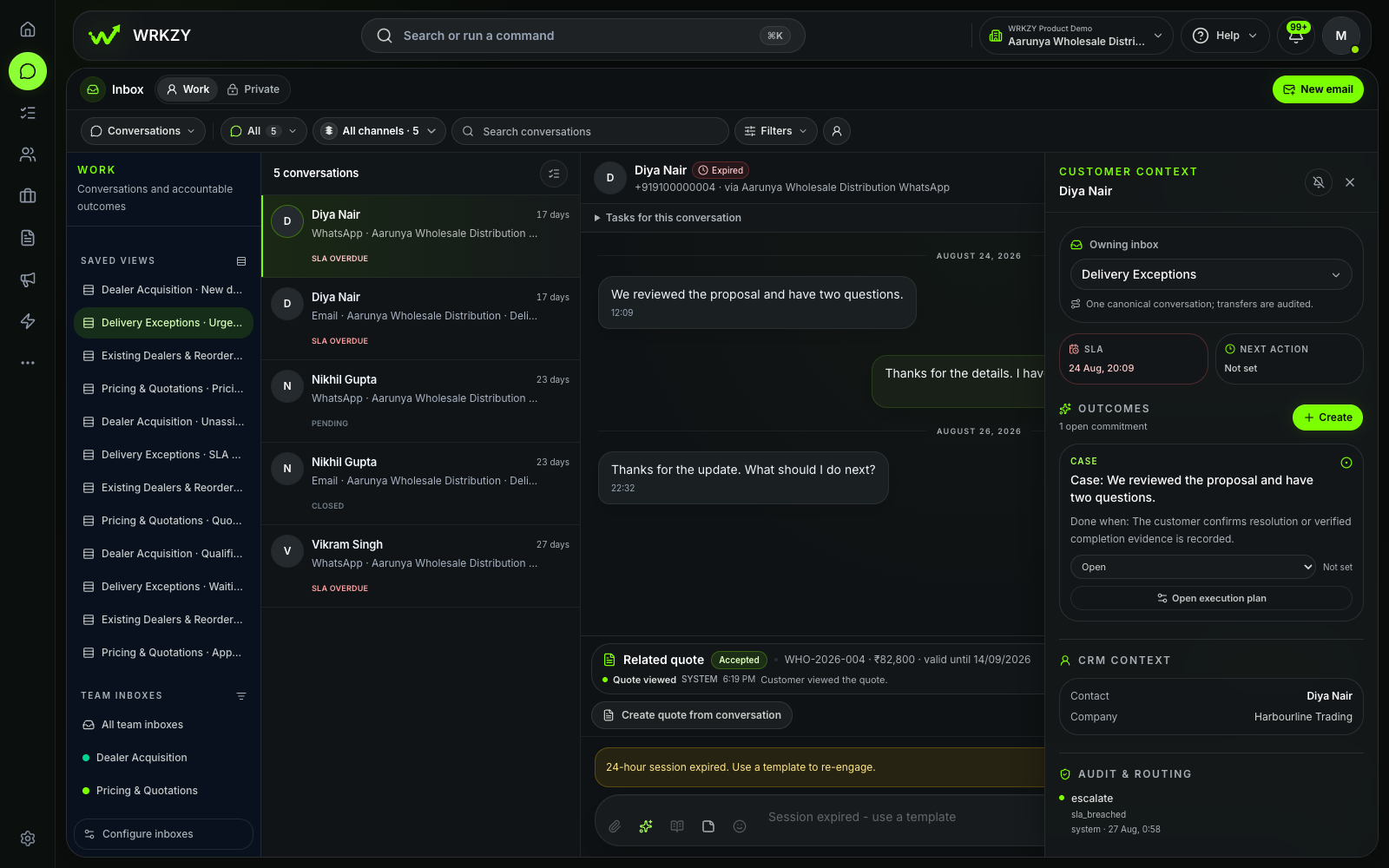 Current productCustomer request, ownership, SLA and outcome contextOpen larger ↗
Evidence boundaryThis capture shows one seeded request at a point in time; it does not establish response-time or resolution guarantees.
The screenshot is useful because it exposes a missing connection instead of hiding it. It does not, by itself, prove the source conversation, complete operating history, or a finished customer outcome.
Fixing the smallest break gives the team a working example before it commits to broader change.
A busy record is not always a useful one
An activity stream is not automatically an operating history. A clear history lets another authorized teammate understand what happened without hunting through side chats.
Capture the customer request, the relevant decision, the owner, the action taken, and the remaining question. Leave out the running commentary that does not change the decision.
Put a time-ordered interaction in the conversation or customer timeline, a commercial decision with the deal or quote it affects, and a promise with a due date in a follow-up or task. See how to add decision-ready customer context.
Try a cold handoff: can an authorized teammate open the record tomorrow and continue without calling the previous owner? If not, the history may contain plenty of activity and still be missing the story.
Notice the questions your team keeps asking
Customer operations can feel abstract until you listen for its symptoms. They sound like this:
- “Where is the latest version?”
- “Who is replying to the customer?”
- “Did we promise Friday or Monday?”
- “Why did this move back to sales?”
- “Has anyone closed the loop?”
These questions are useful diagnostic signals. Track where they recur, then connect the smallest missing part of the workflow before adding more fields or automation.
Measure one journey before changing everything
For one recurring outcome, review a small sample before and after the workflow change:
- measure the time from the first customer signal to a named owner;
- count active items with no owner or no due next action;
- count overdue commitments and reconstruction questions;
- note handoffs, reopenings, or repeated work before completion; and
- check whether an authorized teammate can continue from the shared record without an off-record briefing.
The best setup is not the one with the most fields. It is the one that helps the team understand the customer, make the next decision, and leave a clear path for whoever continues the relationship.
When you are ready to put one connected journey into daily use, follow the 30-day CRM rollout calendar.
If your team regularly rebuilds the same customer story, start there. Explore the WRKZY customer-operations workflow and connect one outcome before mapping every system.